Harare, Zimbabwe — Africa’s richest man and President of the Dangote Group, Aliko Dangote, has announced plans to establish a $1 billion multi-sector industrial complex in Zimbabwe — a project that will combine cement manufacturing, coal mining, and electricity generation under a single integrated facility.
The investment, which marks one of the largest private-sector commitments in Zimbabwe in recent years, is expected to create thousands of direct and indirect jobs while strengthening the country’s industrial base and energy independence.
Dangote Group Expands Footprint in Southern Africa
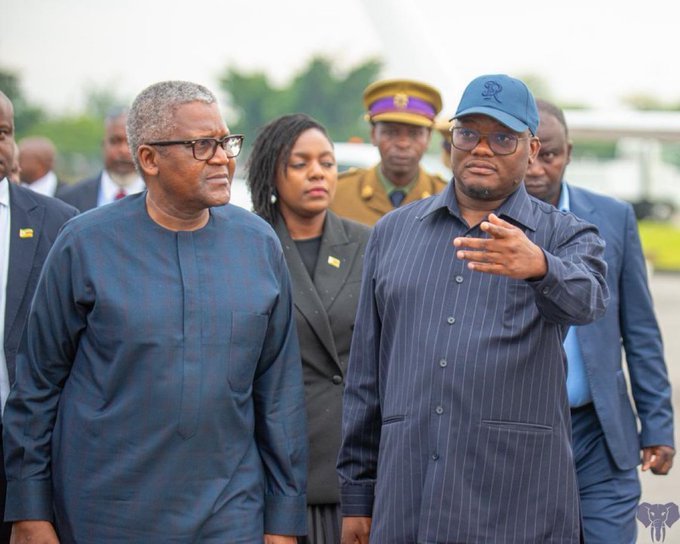
The announcement came after high-level discussions between Aliko Dangote and Zimbabwean President Emmerson Mnangagwa in Harare earlier this week.
According to sources at the meeting, the proposed facility will be located in the Matabeleland region, an area rich in limestone and coal deposits — key raw materials for cement and power generation.
In a statement released on Wednesday, the Dangote Group confirmed its commitment to the project, saying the investment will be implemented in phases and align with Zimbabwe’s National Development Strategy 1 (NDS1), which aims to industrialize the nation by 2030.
“Zimbabwe has immense industrial potential, vast natural resources, and a government that is focused on economic transformation. We believe our investment will contribute meaningfully to job creation, import substitution, and sustainable growth,”
Dangote said.
The facility will integrate a cement production plant, a coal mining operation, and a 100-megawatt (MW) power plant to supply electricity for both the industrial complex and the national grid.
Project Structure and Economic Impact
According to project documents seen by local media, the Dangote Industrial Complex will:
- Produce 2.5 million metric tonnes of cement annually;
- Operate a coal extraction unit to supply both industrial fuel and feedstock for power generation;
- Establish a 100MW thermal power plant to support manufacturing and feed excess electricity into Zimbabwe’s national grid;
- Include a logistics and packaging hub to support regional exports to neighboring countries such as Botswana, Zambia, and Mozambique.
Analysts say the investment could transform Zimbabwe’s industrial landscape, positioning it as a cement and energy hub for Southern Africa.
Currently, Zimbabwe imports a large portion of its cement and power requirements due to underinvestment in infrastructure and manufacturing capacity.
Government Welcomes Dangote’s Commitment
Zimbabwean President Emmerson Mnangagwa hailed the announcement as a “milestone” in the country’s reindustrialization efforts, emphasizing that his administration remains committed to attracting long-term foreign direct investment.
“This partnership with Dangote Group reaffirms confidence in Zimbabwe’s economic trajectory. The government will provide every necessary support to ensure the success of this investment,” Mnangagwa said during the signing ceremony at State House, Harare.
He added that the project aligns with Zimbabwe’s Vision 2030 Agenda, which seeks to transform the country into an upper-middle-income economy by 2030 through private-sector-driven industrialization.
Employment and Skills Development
The new industrial facility is expected to create over 6,000 direct jobs during the construction and operational phases, in addition to thousands of indirect jobs in logistics, mining, and supply chains.
Dangote Group officials confirmed that the company will partner with local technical institutions and vocational centers to train Zimbabwean youths in engineering, mining, and plant management skills.
“We are not just investing in infrastructure; we are investing in people. The project will include a robust capacity-building component to transfer technology and managerial expertise to Zimbabwean workers,”
said Devakumar Edwin, Dangote Group’s Executive Director for Strategy and Operations.
The Group also pledged to adhere to environmental sustainability standards, including modern emission control systems, eco-friendly mining practices, and land rehabilitation programs.
Energy and Industrial Integration
Energy experts say the integration of cement production with coal mining and power generation gives the Dangote Industrial Complex a strategic advantage, enabling operational efficiency and cost savings.
Zimbabwe’s energy sector currently faces frequent power shortages and load shedding, limiting industrial output and economic growth.
The Dangote power plant, expected to generate 100MW, will not only power the industrial complex but also supply surplus electricity to the Zimbabwe Electricity Supply Authority (ZESA), helping stabilize the national grid.
“This is a perfect example of vertical integration. Dangote’s model ensures that each component of the facility supports the others, guaranteeing sustainability and energy security,”
said Dr. Tafadzwa Moyo, an energy analyst based in Bulawayo.
Regional Economic Implications
The project also positions Zimbabwe as an emerging industrial hub in Southern Africa, with potential spillover benefits for neighboring economies.
With the African Continental Free Trade Area (AfCFTA) facilitating regional commerce, Dangote’s new plant could serve as a key export point for cement and industrial materials to surrounding markets, including Zambia, Malawi, Botswana, and Mozambique.
Economists believe this could reduce Zimbabwe’s import dependency, boost foreign exchange earnings, and enhance trade competitiveness.
“This investment aligns with regional integration goals under the AfCFTA. It strengthens Zimbabwe’s production base and opens export opportunities that will improve trade balances,”
said economist Dr. Gift Mugano.
Dangote Group’s Growing African Presence
The Dangote Group, Africa’s largest conglomerate, has operations across 14 African countries, spanning cement, sugar, fertilizer, petrochemicals, and logistics.
Its flagship Dangote Cement currently operates major plants in Nigeria, Ethiopia, Senegal, Tanzania, and South Africa — with a combined installed capacity of over 50 million tonnes per annum.
The Zimbabwe investment marks Dangote’s first large-scale industrial venture in the country, expanding its Southern African footprint and reinforcing its position as a leading private-sector investor on the continent.
Dangote Group has also been involved in energy and mining projects, most notably the Dangote Refinery in Lagos, Nigeria, a $20 billion mega-project that began operations in 2024.
“Our vision is to make Africa self-sufficient in industrial goods and energy. Zimbabwe’s natural resource base makes it a strategic partner in this vision,”
Dangote noted.
Challenges and Policy Support
Despite optimism, analysts caution that Zimbabwe must address policy consistency, power reliability, and currency stability to fully realize the benefits of such large-scale investments.
However, the Mnangagwa administration has pledged regulatory reforms, improved investment protection laws, and streamlined approval processes to facilitate the project’s smooth execution.
“We are committed to creating an enabling environment for investors. Dangote’s confidence in Zimbabwe is a testament to the progress we have made,”
said Industry and Commerce Minister Nqobizitha Ndlovu.
Timeline and Next Steps
Construction of the Dangote Industrial Complex is expected to begin in mid-2026, following completion of feasibility studies, environmental assessments, and infrastructure design.
Initial groundwork — including land acquisition, geological surveys, and community consultations — will commence in early 2026.
The project will be implemented in three phases:
- Phase 1: Establishment of cement plant and supporting infrastructure;
- Phase 2: Development of coal mine and transportation networks;
- Phase 3: Installation of the 100MW power generation facility.
Completion of all phases is projected within three to four years.
Conclusion
Aliko Dangote’s planned $1 billion industrial complex in Zimbabwe signals renewed confidence in the country’s investment potential and underscores the growing importance of intra-African trade and industrial integration.
By combining cement manufacturing, coal extraction, and electricity generation, the Dangote Group is setting a new benchmark for sustainable, vertically integrated industrial development in Africa.
If successfully executed, the project could redefine Zimbabwe’s industrial future — strengthening its economy, creating jobs, and reinforcing Africa’s march toward self-reliance in manufacturing and energy production.