
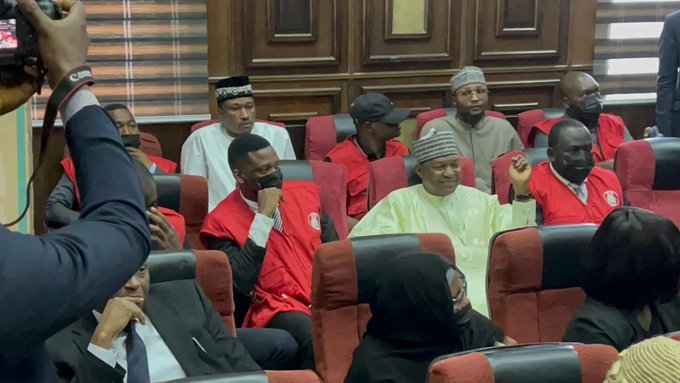
In a dramatic development that has intensified public attention on high-profile corruption prosecutions in Nigeria, a Federal High Court has granted bail in the sum of ₦500 million to former Attorney-General of the Federation and Minister of Justice, Abubakar Malami, his wife, and their son. The ruling, delivered after hours of legal arguments, marks a significant turn in a case that has attracted national debate over accountability, due process, and the treatment of politically exposed persons within Nigeria’s justice system.
The court’s decision followed an application by defence counsel seeking bail pending trial, citing constitutional provisions that presume the innocence of the accused until proven guilty. Prosecutors had opposed the application, arguing that the gravity of the allegations, the profile of the defendants, and the potential risk of interference with witnesses warranted continued detention or, at minimum, extremely stringent bail conditions.
Details of the Court Ruling
In granting the application, the presiding judge held that bail remains a constitutional right and should not be denied as a form of punishment. The court, however, acknowledged the seriousness of the charges and imposed strict conditions to ensure the defendants’ availability for trial.
Under the ruling, each of the three defendants is to meet bail conditions amounting to a cumulative ₦500 million. The court further ordered that reputable sureties of equivalent financial standing be provided, with verifiable assets within the court’s jurisdiction. Passports belonging to the defendants are to be deposited with the court, while travel outside Nigeria without prior judicial approval is prohibited.
The judge emphasized that failure to comply with any of the bail conditions would result in immediate revocation and possible re-arrest. The case was adjourned to a later date for the commencement of full trial proceedings.
Background to the Case
Abubakar Malami served as Nigeria’s Attorney-General of the Federation and Minister of Justice for eight years, a tenure that placed him at the heart of the country’s legal and anti-corruption architecture. As the nation’s chief law officer, he oversaw high-stakes prosecutions, asset recovery initiatives, and legal advice to the federal government.
In recent months, allegations involving financial impropriety, abuse of office, and related offences have been levelled against the former minister and members of his immediate family. Investigative agencies allege that the offences were committed while Malami held public office, though the defendants have consistently denied all accusations, describing them as politically motivated and lacking factual foundation.
The arrest and arraignment of a former Attorney-General, alongside his wife and son, has been widely described as unprecedented, underscoring a renewed push by authorities to demonstrate that no individual is above the law.
Prosecution’s Position
During the bail hearing, counsel to the prosecution argued strongly against granting bail, stressing that the defendants wield significant influence and possess the resources to obstruct investigations if released. Prosecutors also cited the magnitude of the alleged offences and the potential impact on public confidence in the justice system.
They urged the court to consider the need to protect witnesses and preserve evidence, warning that the defendants’ release could compromise the integrity of the trial. In the alternative, the prosecution requested exceptionally high bail conditions to mitigate perceived risks.
Defence Arguments
Defence lawyers countered that their clients had cooperated fully with investigators and had no intention of evading trial. They argued that continued detention would amount to a violation of fundamental human rights, particularly given that the charges remain allegations yet to be tested in court.
The defence also highlighted Malami’s long service to the nation, asserting that he had never failed to honour court summons in the past. According to counsel, the inclusion of Malami’s wife and son in the case further necessitated a humane and balanced approach, especially in the absence of any conviction.
Public Reaction and Political Implications
News of the ₦500 million bail has generated intense reactions across Nigeria. On social media and in political circles, opinions remain sharply divided. Supporters of the former minister view the ruling as affirmation of the rule of law and judicial independence, insisting that bail does not equate to exoneration but ensures fairness.
Critics, however, argue that the bail amount, though substantial on paper, may still be insufficient to deter misconduct among elite defendants. Some civil society groups have called for closer monitoring of compliance with bail conditions, warning that the outcome of the case will serve as a critical test of Nigeria’s anti-corruption resolve.
The involvement of Malami’s family members has also sparked wider debate on the scope of criminal liability and the balance between collective accountability and individual culpability. Legal analysts note that Nigerian law allows for prosecution of any individual reasonably suspected of involvement in alleged offences, regardless of family ties.
Legal Significance
Legal experts say the case could set important precedents in several respects. First, it underscores the judiciary’s willingness to impose heavy financial conditions on politically exposed persons seeking bail. Second, it reinforces the principle that even senior former officials are subject to the same legal processes as ordinary citizens.
The decision also highlights the delicate role courts play in balancing fundamental rights with public interest. By granting bail while imposing stringent safeguards, the court sought to maintain this equilibrium.
What Comes Next
With bail granted, attention now shifts to the substantive trial, where prosecutors will be required to present evidence to support the charges. Defence counsel, on their part, are expected to challenge the credibility of the allegations and the methods used in the investigation.
Observers say the trial could be lengthy, involving complex financial records, witness testimonies, and expert analysis. Given Malami’s former position, the proceedings are likely to attract sustained media coverage and scrutiny from both domestic and international audiences.
Broader Anti-Corruption Context
The case unfolds against the backdrop of renewed government rhetoric on fighting corruption and strengthening institutions. Successive administrations have pledged to recover looted funds and prosecute offenders, though results have often been mixed.
For many Nigerians, the prosecution of a former Attorney-General represents a symbolic moment, testing whether long-standing concerns about selective justice are being addressed. The final outcome of the case may influence public trust in the legal system and shape perceptions of fairness in the enforcement of anti-corruption laws.
Conclusion
The granting of ₦500 million bail to Abubakar Malami, his wife, and son marks a pivotal chapter in one of Nigeria’s most closely watched legal battles. While the ruling affirms constitutional protections and judicial discretion, it also underscores the seriousness of the allegations and the high stakes involved.
As the trial date approaches, all eyes will remain on the court to see whether justice will not only be done but be seen to be done. For now, the bail decision stands as a reminder that in Nigeria’s evolving legal landscape, accountability and due process continue to intersect in complex and consequential ways.