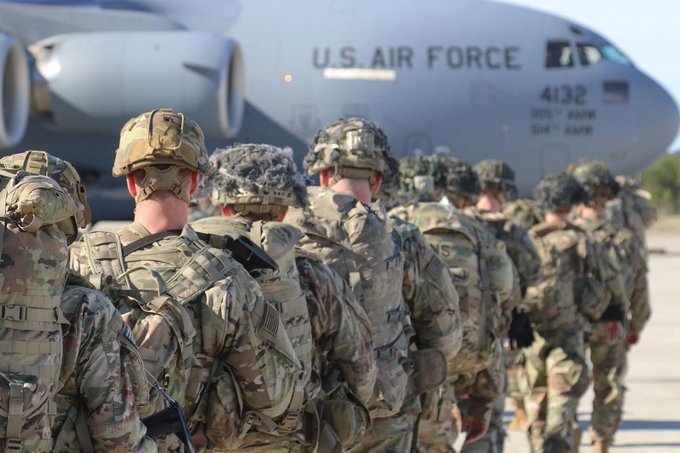
The United States has confirmed the deployment of a small contingent of its military personnel to Nigeria following airstrikes carried out in December, marking a significant escalation in Washington’s direct security engagement with Africa’s most populous country and largest economy.
The deployment, confirmed by US Africa Command (AFRICOM), comes weeks after American forces conducted targeted airstrikes against suspected Islamic State-linked militants operating in parts of northern Nigeria. While US officials insist the newly deployed troops are not meant for large-scale combat operations, the move has triggered intense debate in Nigeria over sovereignty, counterterrorism strategy, and the long-term implications of foreign military presence on Nigerian soil.
Background to the December airstrikes
In December, the United States carried out airstrikes targeting extremist elements described as affiliates of the Islamic State group. The strikes, reportedly conducted on December 25, were aimed at disrupting militant networks accused of orchestrating attacks on civilians and security forces in Nigeria’s troubled northern regions.
US authorities said the airstrikes were carried out based on actionable intelligence and were coordinated with Nigerian counterparts. While Abuja did not immediately provide detailed public commentary on the operation, officials later acknowledged intelligence cooperation with international partners in combating terrorism.
The airstrikes represented a rare instance of direct US kinetic action within Nigeria, underscoring growing concern in Washington about the evolving threat landscape in West Africa. In recent years, extremist violence has spread beyond Nigeria’s northeast, traditionally plagued by Boko Haram and the Islamic State West Africa Province (ISWAP), into the northwest and parts of north-central Nigeria, where banditry and jihadist activities increasingly overlap.
Confirmation of US troop deployment
Following weeks of speculation, AFRICOM confirmed that a “small number” of US military personnel have now been dispatched to Nigeria. According to US officials, the team consists of specialists whose mission is to support Nigeria’s counterterrorism efforts through advisory, intelligence, and capacity-building roles.
American officials emphasised that the troops were deployed at the request, or with the consent, of the Nigerian government, and that their presence is part of longstanding bilateral security cooperation between both countries.
“This deployment is about partnership,” a US defence official said, describing the move as an effort to enhance Nigeria’s ability to counter extremist threats independently rather than replace Nigerian forces on the battlefield.
Although the exact size, location, and duration of the deployment have not been disclosed, officials stressed that the mission is limited in scope and focused on enabling Nigerian security forces.
Nigeria’s evolving security crisis
Nigeria has battled insurgency and violent extremism for more than a decade. Boko Haram’s uprising in the northeast since 2009 has claimed tens of thousands of lives and displaced millions. While the group has been weakened by sustained military pressure, splinter factions, particularly ISWAP, have continued to mount deadly attacks.
In addition to the northeast insurgency, northwestern Nigeria has experienced a surge in violence linked to armed groups commonly described as bandits. What initially began as criminal gangs involved in cattle rustling and kidnappings has, in some cases, evolved into more ideologically driven violence, raising fears of deeper jihadist infiltration.
The Nigerian military has struggled to contain these multiple threats simultaneously, facing challenges including vast terrain, limited resources, intelligence gaps, and public criticism over human rights abuses and operational effectiveness.
Against this backdrop, Nigeria has increasingly leaned on international partners for intelligence sharing, training, and logistical support, even as it remains sensitive to perceptions of foreign military intervention.
A shift in US engagement strategy
The US troop deployment signals a notable shift from Washington’s previously restrained posture in Nigeria. For years, US involvement largely focused on training, intelligence cooperation, and arms sales, with limited on-the-ground presence compared to other theatres such as the Sahel or the Horn of Africa.
Security analysts say the December airstrikes and subsequent troop deployment reflect growing American concern that Nigeria’s security challenges could destabilise a wider region if left unchecked.
West Africa has witnessed a series of military coups, weakening democratic institutions and complicating regional security coordination. At the same time, extremist groups have expanded their reach across porous borders, exploiting governance gaps and local grievances.
Nigeria’s strategic importance — as a major oil producer, economic hub, and diplomatic heavyweight in Africa — makes its stability a priority for US foreign policy.
Nigerian government reaction
The Nigerian government has so far adopted a measured tone regarding the US troop presence. Officials familiar with security discussions say the deployment falls within existing defence cooperation frameworks and does not amount to the establishment of a permanent foreign military base.
Senior security sources indicate that Nigerian authorities are keen to leverage advanced US intelligence, surveillance, and reconnaissance capabilities to improve counterterrorism operations, particularly in remote and hard-to-access areas.
However, the government has also faced pressure to reassure the public that Nigeria retains full control over its security operations and that foreign troops will not operate independently.
Nigeria’s constitution and defence policy emphasise national sovereignty, and past controversies over foreign military involvement have made officials cautious in their public messaging.
Public debate and concerns over sovereignty
News of US troops in Nigeria has sparked lively debate across political, civil society, and academic circles. Supporters argue that Nigeria needs all available help to tackle a security crisis that has persisted for over a decade despite massive defence spending.
They point to the technological superiority and intelligence capabilities of the US military, saying collaboration could save lives and accelerate the defeat of terrorist groups.
Critics, however, warn that foreign military presence risks undermining sovereignty and could provoke backlash from extremist groups, potentially making Nigeria a more prominent target.
Some analysts also question whether external military assistance addresses the root causes of insecurity, such as poverty, unemployment, governance failures, and community grievances.
“There is a danger in focusing too much on military solutions,” one Abuja-based security expert said. “Without addressing the socio-economic drivers of conflict, even the most sophisticated military support may offer only temporary relief.”
Lessons from the region
The US has maintained military deployments across parts of Africa, including Niger, Somalia, and Kenya, often with mixed results. In the Sahel, despite years of foreign military involvement, extremist violence has continued to spread, contributing to political instability and anti-Western sentiment.
Nigeria’s situation, however, differs in key respects. Its military is larger and more experienced, and the country retains stronger institutions than many of its neighbours. US officials believe that targeted support, rather than open-ended deployment, could yield better outcomes.
Still, observers caution that transparency and accountability will be crucial in maintaining public trust and ensuring that cooperation aligns with Nigeria’s national interests.
Implications for Nigeria–US relations
The troop deployment is likely to deepen security ties between Abuja and Washington, potentially extending cooperation into areas such as cyber intelligence, border security, and counter-financing of terrorism.
It could also influence Nigeria’s broader foreign policy posture, particularly as the country balances relationships with other global powers, including China and Russia, both of which have expanded their footprint in Africa.
For the United States, successful cooperation with Nigeria would reinforce its influence in a region where Western presence has faced increasing challenges.
What remains unclear
Despite official confirmation, many details surrounding the US troop deployment remain undisclosed. Neither side has publicly specified where the troops will be based, how long they will remain, or whether their role could expand in the future.
It is also unclear how the deployment fits into Nigeria’s long-term security strategy and whether similar arrangements could be extended or replicated in other parts of the country.
Analysts say clarity on these issues will be essential to avoid misinformation and public anxiety.
A defining moment in Nigeria’s security fight
The arrival of US troops after December’s airstrikes marks a defining moment in Nigeria’s long-running battle against terrorism and violent insecurity. It underscores both the severity of the threat Nigeria faces and the willingness of international partners to play a more direct role.
Whether the deployment will translate into measurable security gains remains to be seen. What is certain, however, is that Nigeria’s security challenges have reached a level where purely domestic solutions are increasingly complemented by international cooperation.
As Nigeria navigates this new phase, the balance between partnership and sovereignty, short-term security gains and long-term stability, will shape the outcome of one of the most consequential security decisions in recent years.