
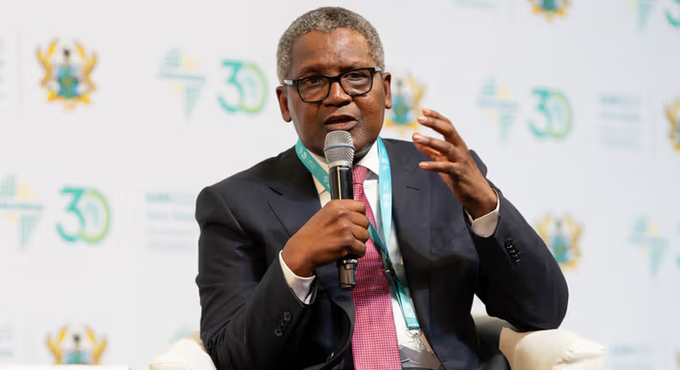

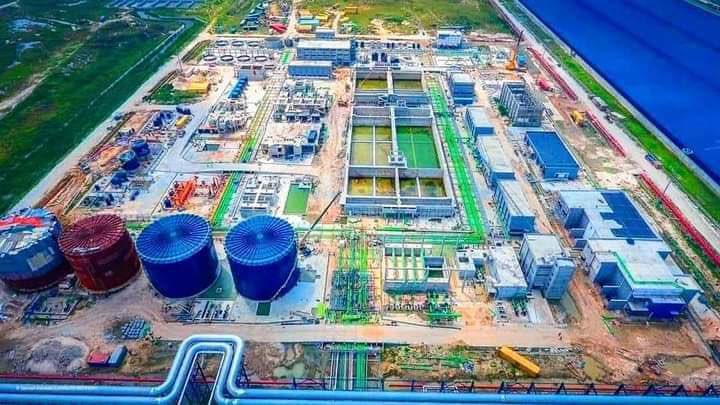
Africa’s foremost industrialist, Aliko Dangote, has announced plans to construct what is projected to be Africa’s largest detergent raw material manufacturing plant in Nigeria, as the Dangote Industries Limited refinery reaches full operational capacity.
The development signals a significant expansion of Dangote’s petrochemical footprint and reinforces Nigeria’s ambition to become a continental hub for industrial production and value-added manufacturing.
Refinery Reaches Full Capacity
The announcement comes on the heels of confirmation that the Dangote Refinery has reached full processing capacity, marking a historic milestone in Nigeria’s oil and gas sector.
Located in the Lekki Free Trade Zone in Lagos State, the refinery is one of the largest single-train refineries in the world. It was designed to process 650,000 barrels of crude oil per day, producing refined petroleum products including petrol, diesel, aviation fuel, and petrochemical feedstock.
Industry analysts say the refinery’s attainment of full capacity strengthens backward integration opportunities and provides feedstock support for downstream industries such as plastics, fertilizers, and now detergent raw materials.
Africa’s Largest Detergent Raw Material Plant
According to company officials, the new plant will focus on producing key raw materials used in detergent manufacturing, particularly linear alkylbenzene (LAB), a primary ingredient in household cleaning products.
Currently, a substantial portion of detergent raw materials used across Africa is imported from Europe, Asia, and the Middle East. The proposed facility aims to reverse that trend by:
- Reducing dependence on imports;
- Lowering production costs for local manufacturers;
- Boosting export potential across West and Central Africa;
- Creating thousands of direct and indirect jobs.
Executives at Dangote Industries stated that the project aligns with Nigeria’s broader industrialization strategy, leveraging the refinery’s petrochemical outputs to stimulate local manufacturing.
Strategic Industrial Expansion
The new plant is expected to be integrated within the refinery’s petrochemical ecosystem. By utilizing feedstock generated internally, the detergent raw material facility will benefit from lower input costs and streamlined supply chains.
Experts describe the move as a classic case of vertical integration — where a company expands operations across different stages of production to maximize efficiency and profitability.
This strategy has been a hallmark of Dangote’s business model, previously demonstrated in cement manufacturing and fertilizer production.
Economic Implications for Nigeria
The establishment of Africa’s largest detergent raw material plant is projected to have far-reaching economic implications:
1. Import Substitution
Nigeria spends billions of naira annually on importing industrial raw materials. Domestic production of detergent inputs could conserve foreign exchange and strengthen the naira.
2. Job Creation
Large-scale petrochemical projects typically generate employment across engineering, construction, logistics, and operations.
3. Industrial Growth
The availability of affordable raw materials could encourage the growth of small- and medium-scale detergent producers.
4. Export Revenue
With Nigeria strategically positioned within ECOWAS, the plant could serve as a major export hub to neighboring countries.
Economists note that local production of LAB and related compounds may also reduce the cost of household cleaning products for Nigerian consumers.
Refinery as Catalyst for Diversification
The Dangote Refinery has been positioned not merely as an oil refining project but as a catalyst for Nigeria’s broader economic diversification.
Beyond producing refined fuels, the refinery complex includes petrochemical units capable of manufacturing polypropylene and other industrial inputs. The addition of a detergent raw material plant further broadens its downstream portfolio.
Industry stakeholders argue that this approach enhances value addition within Nigeria’s hydrocarbon value chain, rather than exporting crude oil and importing finished goods.
Government and Industry Reaction
Though formal statements from government officials are still emerging, economic observers anticipate strong federal support for the initiative.
The Nigerian government has consistently emphasized local content development and industrial capacity expansion as key pillars of economic policy.
Private sector leaders have also welcomed the announcement, describing it as a transformative step for Nigeria’s manufacturing sector.
Manufacturers in the fast-moving consumer goods (FMCG) industry see potential cost savings and supply stability if raw materials become locally available.
Regional Significance
The plant’s designation as Africa’s largest underscores its continental significance. Africa’s detergent market has expanded rapidly in recent years due to urbanization, population growth, and rising hygiene awareness.
By producing detergent inputs locally, Nigeria could:
- Strengthen its leadership role in West Africa’s industrial landscape;
- Compete with established petrochemical hubs in North Africa;
- Attract multinational manufacturers seeking regional supply bases.
Trade analysts believe the project could reshape supply chains across sub-Saharan Africa.
Infrastructure and Sustainability Considerations
Large-scale petrochemical facilities typically require robust infrastructure — including power generation, water supply, and transport networks.
The Dangote refinery complex already includes supporting infrastructure such as deep-sea port access and power plants, which could facilitate the new project’s integration.
Environmental experts, however, stress the importance of strict compliance with environmental regulations and sustainable production standards, given the chemical-intensive nature of detergent raw material manufacturing.
Timeline and Investment Outlook
While specific timelines for construction have not yet been publicly disclosed, industry insiders suggest that preliminary planning is already underway.
Given Dangote Industries’ track record of executing multi-billion-dollar projects, analysts anticipate that financing and engineering frameworks will be structured to ensure timely delivery.
Market watchers also predict that the move could enhance investor confidence in Nigeria’s industrial sector.
Broader Impact on Consumers
Beyond macroeconomic benefits, the project could influence everyday consumer experiences.
Local availability of detergent raw materials may:
- Reduce retail prices over time;
- Stabilize supply chains during global disruptions;
- Encourage innovation in locally branded cleaning products.
Manufacturers would have greater flexibility to scale production and meet domestic demand.
Conclusion
The announcement that Aliko Dangote will build Africa’s largest detergent raw material plant in Nigeria, following the refinery’s achievement of full operational capacity, marks a pivotal moment in the country’s industrial evolution.
By leveraging petrochemical outputs to produce essential manufacturing inputs, Dangote Industries is deepening vertical integration and reinforcing Nigeria’s ambition to become a leading industrial powerhouse in Africa.
As construction plans advance, stakeholders across manufacturing, trade, and policy circles will closely monitor the project’s progress — recognizing its potential to reshape not just Nigeria’s detergent industry, but the broader African petrochemical landscape.
Further details regarding investment size, construction timelines, and production capacity are expected in the coming weeks.