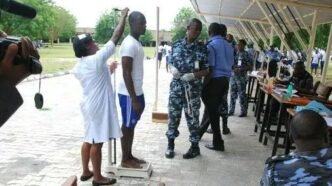
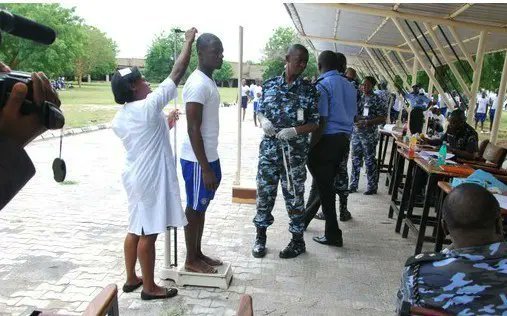
Nigeria has commenced the physical and credential screening phase for thousands of applicants seeking recruitment into the Nigeria Police Force as constables, marking a major step in the ongoing effort to strengthen the country’s internal security architecture.
The screening exercise, organized in collaboration with the Police Service Commission, officially begins on March 9, 2026, and will run until April 18, 2026, across the 36 states and the Federal Capital Territory. The nationwide exercise is part of the federal government’s plan to recruit 50,000 new police constables into the Nigeria Police Force.
Authorities say the screening stage will determine which candidates progress to the next phases of the recruitment process.
Nationwide Screening Exercise Begins
Officials confirmed that the physical and credential screening will take place at designated venues in each state, including police command headquarters and training institutions. Successful applicants who completed the earlier online registration phase have been invited to participate in the screening according to scheduled dates indicated on their invitation slips.
According to recruitment guidelines issued by the Police Service Commission, the exercise will involve verification of credentials, physical assessment, and documentation checks to confirm the eligibility of candidates.
The screening is expected to be conducted daily, typically beginning around 7:00 a.m., with applicants required to appear strictly on the date assigned to them.
Police authorities warned that candidates who fail to appear on their scheduled date or arrive without the required documentation will not be allowed to participate in the screening exercise.
Required Documents for Screening
Applicants invited for the screening are expected to present several documents for verification. Officials said candidates must come with the original copies of their credentials as well as printed forms generated during the online application process.
The mandatory documents include:
- Application submission slip
- Invitation slip with assigned table number
- Physical screening form
- Credentials screening form
- National Identity Number (NIN) printout or NIMC card
- O’Level certificate such as WAEC, NECO, GCE, or NABTEB
- Birth certificate or declaration of age
- Certificate of local government or state of origin
- Completed guarantor’s form with passport photographs
Specialist applicants are also expected to provide relevant trade test certificates or professional qualifications where applicable.
Authorities emphasized that all documents must be properly arranged, often in white flat files, to facilitate an orderly screening process.
Mandatory Dress Code for Applicants
In addition to presenting the required documentation, applicants must also comply with a strict dress code during the screening exercise.
Candidates are instructed to appear in:
- White T-shirt
- White shorts
- White canvas shoes
- White stockings
Police spokespersons explained that the dress code is designed to allow examiners to properly assess the physical fitness of applicants during the screening stage.
Applicants who fail to comply with the specified dress code may be disqualified from participating in the exercise.
Recruitment Drive to Strengthen Security
The ongoing recruitment exercise forms part of broader efforts by the Nigerian government to expand the manpower of the police force amid rising security challenges across the country.
In 2025, President Bola Ahmed Tinubu approved the recruitment of 50,000 new police officers to boost the operational capacity of the force and enhance internal security nationwide.
Officials said the initiative is aimed at addressing manpower shortages in the police and improving response to crimes such as terrorism, kidnapping, armed robbery, and other violent offences.
Security experts have repeatedly noted that Nigeria’s police-to-population ratio remains significantly below international recommendations, making recruitment drives such as this crucial for strengthening law enforcement capabilities.
Application Process and Participation
The recruitment process began with an online application phase which ran between December 15, 2025, and January 2026, during which interested candidates submitted their details through the official recruitment portal.
Due to lower-than-expected applications from some states, the deadline was later extended by the Police Service Commission to encourage more eligible Nigerians to apply.
By the time the portal closed, hundreds of thousands of applicants had registered nationwide.
However, only those who met the eligibility criteria and were shortlisted after the initial screening stage were invited to attend the physical and credential verification exercise now underway.
Eligibility Requirements for Applicants
To qualify for recruitment into the Nigeria Police Force as constables, applicants must meet several eligibility conditions.
Key requirements include:
- Nigerian citizenship by birth
- Age between 18 and 25 years
- Minimum of five credits in O’Level examinations, including English Language
- Physical and mental fitness
- Good character and no criminal record
Candidates are also expected to demonstrate discipline, physical endurance, and other attributes required for law enforcement duties.
These criteria form part of efforts by the Police Service Commission to ensure that only competent and qualified individuals are recruited into the force.
Warning Against Fraud and Recruitment Scams
Authorities have reiterated that the recruitment exercise is completely free of charge, warning applicants to beware of individuals or groups demanding money in exchange for assistance or preferential treatment.
Officials from the Police Service Commission emphasized that any attempt to collect fees from applicants is illegal and should be reported immediately.
They also cautioned candidates to rely only on official information released by the police or the commission to avoid falling victim to online recruitment scams.
According to the commission, anyone caught exploiting applicants during the recruitment process will face prosecution.
State Police Commands Coordinate Exercise
State police commands across the federation have been tasked with coordinating the screening exercise in their respective jurisdictions.
In several states, police spokespersons confirmed that arrangements have been finalized to ensure a smooth and orderly screening process.
Applicants have been urged to remain calm, follow instructions from officials, and maintain discipline throughout the exercise.
Authorities say adequate security and logistical arrangements have been put in place at screening venues to manage the large number of candidates expected to participate.
Next Stages of the Recruitment Process
Following the physical and credential screening, successful candidates will proceed to the next stages of the recruitment process.
These stages typically include:
- Medical examination
- Background checks
- Training at police colleges or training schools
Candidates who successfully complete all stages will then be formally enlisted into the Nigeria Police Force as constables.
Training programs are designed to equip recruits with the skills required for policing duties, including crime prevention, investigation techniques, community policing, and tactical operations.
Public Expectations and Security Outlook
The recruitment of 50,000 constables is widely seen as a significant step toward improving Nigeria’s security framework.
Analysts believe that increasing the number of trained police personnel could enhance the ability of the government to tackle crime and improve safety across the country.
However, they also stress that recruitment must be accompanied by reforms in training, welfare, and equipment for officers to ensure effective policing.
For now, the screening exercise marks a critical phase in what is expected to be one of the largest police recruitment drives in Nigeria’s recent history.
As the nationwide screening continues, thousands of hopeful applicants will be aiming to secure a place among the new generation of officers tasked with safeguarding the nation.