
Lagos, Nigeria — October 26, 2025:
In a landmark development for Africa’s energy landscape, the Dangote Petroleum Refinery, the continent’s largest single-train refinery, has announced plans to double its production capacity from 650,000 barrels per day (bpd) to an astonishing 1.4 million bpd.
The announcement marks a major step forward in Nigeria’s long-standing ambition to achieve energy self-sufficiency, reduce its dependence on imported refined petroleum products, and transform itself into a major exporter of refined fuels across Africa and beyond.
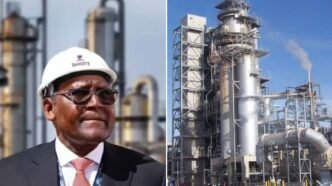
Speaking at a press briefing in Lagos on Sunday, the President of the Dangote Group, Alhaji Aliko Dangote, said the expansion project would commence immediately, with full-scale operations expected to begin by 2027. The upgrade, he explained, will involve the construction of additional processing units, the integration of advanced refining technologies, and strategic partnerships with global engineering firms to ensure efficiency and sustainability.
A Bold Vision for Energy Dominance
Aliko Dangote described the expansion as “a bold but necessary step” to position Nigeria as a refining powerhouse capable of meeting domestic demand and serving as a supply hub for Africa, Europe, and parts of Asia.
“Our goal has always been to make Nigeria self-sufficient in refined products and to help stabilize the energy market across Africa,” Dangote said. “With this expansion to 1.4 million barrels per day, we will not only meet local demand but also become a major exporter of premium petroleum products globally.”
According to Dangote, the refinery’s expansion plan aligns with the Nigerian government’s Energy Transition and Industrialization Agenda, which seeks to maximize the value of the nation’s crude oil resources while reducing environmental impact.
Details of the Expansion Plan
The Dangote Refinery, which officially began partial operations in early 2025, currently refines crude oil into petrol, diesel, aviation fuel, kerosene, and polypropylene.
With the planned expansion, the facility will include:
- New distillation units capable of processing additional grades of crude oil.
- Upgraded petrochemical and fertilizer integration to enhance value addition.
- A new gas treatment and recovery system to reduce emissions and improve energy efficiency.
- An expanded export terminal and jetty to handle larger shipments to international markets.
- A stronger domestic distribution network, ensuring reliable product availability across Nigeria and neighboring countries.
Dangote explained that the refinery’s location in the Lekki Free Trade Zone, Lagos, offers strategic logistical advantages for both domestic supply and global export routes.
Economic Impact: Boosting Nigeria’s GDP and Forex Earnings
Experts say the refinery’s expansion could significantly boost Nigeria’s gross domestic product (GDP), reduce foreign exchange pressure, and strengthen the naira.
Currently, Nigeria spends over $10 billion annually importing refined petroleum products, despite being Africa’s largest crude oil producer. With the refinery doubling its output, the country could save billions in foreign exchange while generating substantial export revenue.
Economist and energy analyst, Dr. Aisha Bello, said the development would mark “a turning point in Nigeria’s industrial evolution.”
“If fully implemented, this will be one of the biggest industrial achievements in Africa’s history,” Bello said. “It will stabilize fuel prices, reduce inflationary pressure from energy imports, and open new employment and investment opportunities.”
She added that the refinery’s increased capacity could attract ancillary industries, including petrochemicals, lubricants, plastics, and packaging, potentially creating over 50,000 direct and indirect jobs.
Government Reaction: A Milestone for Energy Independence
The Nigerian government has hailed the Dangote Refinery’s expansion plan as a major contribution to national development.
Minister of Petroleum Resources (Oil), Senator Heineken Lokpobiri, praised Dangote for his vision and commitment to industrial growth, noting that the expansion aligns perfectly with the administration’s goal of ensuring that Nigeria refines what it produces.
“What Aliko Dangote is doing is historic,” Lokpobiri said. “Nigeria has been importing fuel for decades, but with this expansion, we can finally reverse that trend. This project will make our country a net exporter of refined products and a leader in energy infrastructure.”
He assured that the government would provide all necessary regulatory support and infrastructure to ensure the refinery operates at full capacity, including stable power supply, improved access roads, and efficient port logistics.
Regional and Global Implications
The Dangote Refinery’s planned expansion is expected to reshape global oil trade flows, especially across Africa and parts of Europe.
Several West and Central African countries currently depend on imported fuel from Europe and Asia. Analysts predict that once Dangote’s expanded facility becomes operational, Nigeria could supply over 70% of West Africa’s refined fuel demand, displacing European exports and lowering logistics costs across the region.
Energy consultant Michael Adeyemi noted that the development could also strengthen Nigeria’s geopolitical influence.
“This refinery expansion places Nigeria at the heart of Africa’s energy network,” Adeyemi said. “It will not only drive regional integration but also position the country as a strategic energy supplier to key markets.”
He added that the move could enhance Nigeria’s bargaining power in global oil markets, particularly within OPEC and African energy blocs, as refined products gain increasing relevance in trade negotiations.
Sustainability and Environmental Considerations
Dangote Group officials emphasized that the refinery’s expansion would incorporate advanced environmental management systems to minimize emissions and ensure compliance with international standards.
The company said it plans to adopt carbon capture and storage (CCS) technology and zero-flaring policies to promote sustainability.
Environmental engineer Dr. Funmi Okonjo praised the initiative, noting that the inclusion of cleaner technologies shows Dangote’s awareness of global climate goals.
“Expanding refinery capacity while committing to low-carbon operations is a forward-thinking approach,” she said. “This could set a model for industrial development across Africa.”
Challenges Ahead
While the announcement has sparked excitement across Nigeria, experts caution that the project’s success will depend on stable policy environments, efficient logistics, and adequate crude oil supply.
Nigeria’s oil production has fluctuated in recent years due to pipeline vandalism, theft, and underinvestment in upstream operations. Analysts stress that ensuring a steady crude supply to the refinery is essential to sustain operations at the new capacity.
The Nigerian National Petroleum Company Limited (NNPC Ltd.), which holds a minority stake in the refinery, has pledged its support to ensure uninterrupted crude deliveries.
NNPC spokesperson Olufemi Soneye said, “We are committed to working with Dangote Refinery to guarantee a consistent flow of feedstock. This is a national project, and its success is in everyone’s interest.”
A Symbol of African Industrial Renaissance
Beyond its economic and energy implications, the expansion of the Dangote Refinery symbolizes Africa’s growing capacity for large-scale industrial innovation.
By scaling up production to 1.4 million barrels per day, the facility will rival some of the world’s largest refineries in India, the United States, and South Korea — positioning Africa as a significant player in the global downstream oil sector.
Industry experts describe the move as a “game changer” that could redefine the continent’s industrial narrative.
“This is not just a Nigerian achievement; it’s an African success story,” said Dr. Ngozi Nwosu, an energy economist. “It demonstrates what visionary leadership, strategic investment, and private-sector determination can achieve on the continent.”
Conclusion
The announcement that the Dangote Refinery will double its production capacity to 1.4 million barrels per day stands as one of the most transformative developments in Nigeria’s modern history.
If successfully executed, it promises to revolutionize the country’s energy sector, strengthen the economy, create thousands of jobs, and position Nigeria as a dominant force in the global oil refining market.
For many Nigerians, the news represents not just industrial progress but also a beacon of hope — a sign that the dream of energy independence and economic transformation is finally within reach.