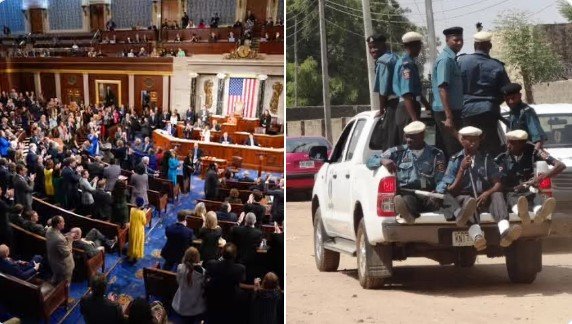
A fresh wave of international attention has turned toward Nigeria’s complex legal and religious landscape following a call by a coalition of activists and advocacy groups urging the United States Congress to pressure the Nigerian government to declare the application of Sharia law unconstitutional and to disband the Hisbah commissions operating in several northern states.
The appeal, which has begun to circulate widely among diplomatic, policy, and human rights circles, has reignited long-standing debates about constitutionalism, religious freedom, federalism, and human rights in Africa’s most populous nation. It also places Nigeria once again at the intersection of domestic sovereignty and international scrutiny over governance, civil liberties, and the rule of law.
While Nigerian authorities have not yet issued an official response to the development, the call has already triggered intense reactions across political, religious, and civil society groups both within Nigeria and in the diaspora.
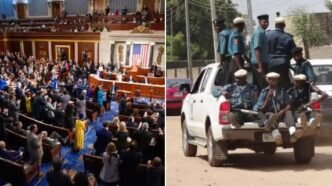
The Call to the US Congress
According to the campaigners behind the appeal, the request to the US Congress is rooted in concerns about what they describe as “systemic violations of constitutional rights” in states where Sharia law is applied alongside Nigeria’s secular legal framework. The activists argue that certain aspects of Sharia enforcement infringe on fundamental freedoms guaranteed under Nigeria’s 1999 Constitution, including freedom of religion, freedom of movement, and equality before the law.
They are also asking American lawmakers to use diplomatic pressure, legislative tools, and international human rights mechanisms to compel the Nigerian government to dismantle the Hisbah commissions—religious enforcement bodies established by several northern states to monitor compliance with Islamic moral codes.
Supporters of the petition allege that Hisbah operatives have, over the years, been involved in arbitrary arrests, harassment of non-Muslims, destruction of property, and enforcement actions that exceed the powers granted to state institutions under Nigeria’s federal constitution.
Understanding Sharia Law in Nigeria
Nigeria operates a dual legal system that blends statutory law, customary law, and, in some states, Islamic law. Since 1999, following the return to democratic rule, twelve states in northern Nigeria have formally adopted Sharia law for criminal and civil matters involving Muslims.
These states include Zamfara, Kano, Katsina, Sokoto, Jigawa, Kebbi, Bauchi, Borno, Yobe, Gombe, Niger, and Kaduna (partially). Under this arrangement, Sharia applies mainly to Muslims, while non-Muslims are theoretically exempt and subject to conventional courts.
Proponents of Sharia argue that its adoption reflects the will of the people in predominantly Muslim states and falls within the constitutional rights of states to legislate on matters not exclusively reserved for the federal government. They also insist that non-Muslims are not compelled to submit to Islamic law and that safeguards exist to protect religious minorities.
Critics, however, maintain that in practice, the boundaries are often blurred, particularly in public spaces where Hisbah operatives enforce moral codes that affect both Muslims and non-Muslims alike.
The Role and Controversy of Hisbah Commissions
Hisbah commissions were created by state governments to promote moral conduct and ensure compliance with Islamic ethics as defined under Sharia law. Their duties typically include discouraging alcohol consumption, regulating social behavior, preventing gambling, enforcing dress codes, and mediating domestic disputes.
Over the years, Hisbah agencies have generated significant controversy. Human rights groups have accused them of operating as parallel security outfits without clear constitutional backing. There have been documented instances of clashes between Hisbah operatives and federal security agencies, particularly the police, over jurisdiction and authority.
Supporters of Hisbah argue that the bodies play a vital role in community policing, crime prevention, moral reorientation, and social welfare. They insist that Hisbah operations are rooted in local values and enjoy widespread support among residents of Sharia-implementing states.
Opponents, however, insist that the commissions have overstepped their mandate and that their activities undermine Nigeria’s secular constitution and international human rights obligations.
Constitutional and Legal Dimensions
Nigeria’s Constitution explicitly prohibits the adoption of a state religion at the federal level while guaranteeing freedom of thought, conscience, and religion. This delicate balance has fueled persistent legal debates over whether the expansion of Sharia into criminal justice in some states violates the spirit or letter of the constitution.
While Sharia personal law has long been recognized in matters such as marriage, divorce, and inheritance, its extension into criminal law after 1999 sparked national and international controversy. Several legal scholars argue that criminal Sharia law conflicts with constitutional provisions on equality, fair hearing, and freedom from inhuman or degrading punishment.
However, Nigeria’s courts have so far avoided making a sweeping declaration that criminal Sharia law is unconstitutional. Instead, cases are often decided on technical grounds, jurisdictional issues, or specific rights violations, leaving the broader constitutional question unresolved.
The renewed call for US Congress intervention is therefore seen by observers as an attempt to internationalize a debate that has remained largely domestic for over two decades.
International Pressure and Nigeria’s Sovereignty
The request for American legislative action raises significant geopolitical and diplomatic questions. Nigeria is a sovereign nation with an independent legal system, and foreign pressure on its internal religious and constitutional arrangements could provoke strong backlash.
Historically, Nigeria has resisted external interference in sensitive domestic issues, particularly those touching on religion, security, and governance. Government officials have repeatedly emphasized the principle of non-intervention and national sovereignty in responding to foreign criticism.
Nevertheless, Nigeria is also a signatory to multiple international human rights treaties and maintains strategic partnerships with the United States, the European Union, and international organizations. These partnerships often include dialogue on democracy, human rights, and the rule of law.
Analysts warn that if the issue gains traction in the US Congress, it could lead to hearings, resolutions, or policy statements that place additional diplomatic pressure on Abuja, even if such actions fall short of formal sanctions.
Reactions Within Nigeria
The call to dismantle Sharia and disband Hisbah has triggered polarized reactions across Nigeria’s diverse religious and political landscape.
In parts of southern Nigeria and among secular advocacy groups, the development has been greeted with cautious optimism. Many of these groups have long argued that Nigeria must reinforce the secular foundations of its constitution and ensure that religious laws do not infringe on civil liberties.
They contend that the existence of state-backed religious enforcement agencies sets a dangerous precedent and weakens national unity in a multi-ethnic, multi-religious federation.
Conversely, leaders in Sharia-implementing states have strongly defended both Sharia law and Hisbah institutions. They describe the call to the US Congress as an attack on religious freedom, cultural identity, and the rights of states to govern themselves in accordance with the wishes of their people.
Some northern leaders have warned that any attempt to externally coerce Nigeria on religious matters could fuel tension, deepen mistrust, and worsen existing security challenges in the region.
Religious Sensitivities and National Unity
Religion remains one of the most sensitive fault lines in Nigeria. The country is almost evenly divided between Muslims and Christians, with deep historical, cultural, and political implications. Past attempts to alter religious balances or impose sweeping reforms have often sparked unrest, protests, and, in extreme cases, violence.
The re-emergence of the Sharia debate on an international stage risks reopening old wounds, particularly in a period when Nigeria is already grappling with economic hardship, insecurity, and social tensions.
Faith leaders on both sides have called for restraint in rhetoric and action. Some Christian leaders have urged the federal government to clarify its position on the constitutional status of Sharia and Hisbah, while Muslim clerics have cautioned against what they perceive as foreign-sponsored attacks on Islamic institutions.
Human Rights and International Law Perspective
From a human rights standpoint, the controversy touches on competing rights: the right to freedom of religion and the right to equality and personal liberty. International conventions recognize both, but balancing them in plural societies remains one of the most difficult governance challenges worldwide.
Advocates pushing for the disbandment of Hisbah commissions argue that any state-backed body enforcing religious morality inherently risks abuse of power. They insist that law enforcement should remain the exclusive domain of constitutionally recognized agencies.
Those defending Hisbah counter that the commissions emerged to fill gaps in community policing and moral enforcement, especially in areas where conventional security structures were weak. They maintain that problems of abuse should be addressed through reform and oversight, not outright abolition.
Potential Implications for Nigeria–US Relations
Should the issue gain momentum in Washington, it could introduce a new layer of complexity into Nigeria–US relations. The two countries cooperate closely on security, counterterrorism, trade, health, and education. Diplomatic friction over religious law could strain this partnership, particularly if it becomes linked to aid, security cooperation, or human rights conditionalities.
Nigeria’s response will likely be guided by a combination of constitutional interpretation, political calculations, and efforts to maintain regional stability. Federal authorities may also seek to avoid any perception of yielding to foreign pressure, which could carry significant domestic political costs.
What Happens Next?
As of now, the call to the US Congress remains at the advocacy stage. There is no confirmation that formal legislative action has been initiated in Washington. Similarly, the Nigerian government has yet to issue an official position on the matter.
What is clear, however, is that the controversy has once again thrust Nigeria’s Sharia system and Hisbah commissions into the global spotlight. The outcome will depend on how both domestic institutions and international actors navigate the sensitive intersection of law, religion, and sovereignty.
Legal experts expect that any lasting resolution to the constitutional questions surrounding Sharia and Hisbah must ultimately come from Nigeria’s courts and legislature, not from foreign governments. They argue that sustainable reform can only be achieved through inclusive national dialogue, judicial clarity, and respect for Nigeria’s diverse religious and cultural realities.
A Test of Federalism, Rights, and Diplomacy
The renewed international attention on Sharia law and Hisbah commissions represents more than a legal dispute; it is a test of Nigeria’s federal structure, its commitment to human rights, and its ability to manage religious diversity within a constitutional democracy.
As debate intensifies at home and abroad, Nigerians across all faiths will be watching closely to see how their leaders respond—whether with dialogue, legal reform, or diplomatic resistance. The decisions taken in the coming months could shape not only the future of religious law in Nigeria but also the country’s standing in the global human rights and diplomatic arena.