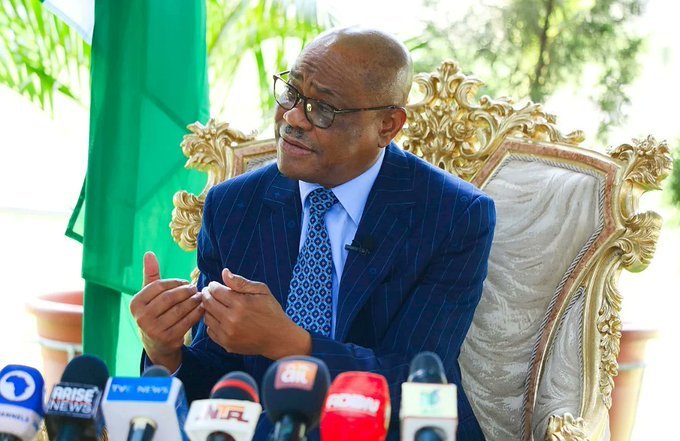
The Minister of the Federal Capital Territory (FCT), Nyesom Wike, has assured residents of Abuja that ongoing and planned development projects across the capital will not be disrupted by political activities, including the forthcoming Area Council Elections scheduled for February 21.
Wike gave the assurance on Wednesday during an inspection tour of several major infrastructure projects currently underway in the Federal Capital Territory. He stressed that governance, service delivery, and infrastructural development would continue uninterrupted, regardless of political timelines or electoral engagements.
According to the minister, the primary responsibility of government is to serve the people, insisting that politics must never be allowed to derail development or compromise the welfare of residents.
“Politics is different. You have to serve the people. Politics has its own time, and the work will continue to go on. Politics is not going to affect it,” Wike said while addressing journalists at one of the project sites.
Separating governance from politics
Wike’s remarks come amid heightened political activities in Abuja as political parties, candidates, and stakeholders prepare for the upcoming Area Council Elections, which will determine leadership at the grassroots level in the nation’s capital.
The minister made it clear that while elections are an essential part of democratic governance, they must not distract public officials from their core mandate of delivering tangible benefits to citizens.
He emphasised that the FCT Administration remains firmly committed to its development agenda, adding that contracts awarded for infrastructure projects are being executed based on clear timelines and performance benchmarks that will not be altered due to political considerations.
“People elected us, or appointed us, to work,” Wike said. “They didn’t bring us here to stop development because of politics. Residents want roads, schools, hospitals, water, and security. That is what we are focused on.”
Inspection of key infrastructure projects
During the inspection tour, Wike visited several ongoing projects across different parts of the FCT, including road construction, rehabilitation works, and other public infrastructure designed to improve mobility, safety, and overall quality of life for residents.
He expressed satisfaction with the pace and quality of work at most of the sites, while also issuing directives to contractors to ensure strict adherence to specifications and deadlines.
The minister reiterated that his administration would not tolerate delays, substandard execution, or excuses tied to political events.
“If you are given a job to do, you must do it well and on time,” he said. “Election or no election, contracts must be delivered.”
Focus on residents’ welfare
Wike stressed that development in the FCT is ultimately about improving the living conditions of residents, many of whom have endured years of inadequate infrastructure, traffic congestion, and uneven development between the city centre and satellite towns.
According to him, the current FCT leadership is determined to bridge that gap by extending development to both urban and rural communities, including the six Area Councils.
“Our concern is the welfare of the people,” he said. “Whether you live in the city centre or in the satellite towns, you deserve good roads and basic infrastructure. That is what we are working towards.”
He added that projects in rural and semi-urban communities would continue alongside those in high-profile districts, dismissing claims that development is concentrated only in select areas.
Area Council Elections and governance continuity
The Area Council Elections are a significant political event in the FCT, as they determine leadership at the grassroots level, where local governance directly affects daily life through primary education, markets, sanitation, and community development.
Wike noted that while the elections are important for democratic participation, they should not create uncertainty or slow down government activities.
He assured residents that the FCT Administration has put structures in place to ensure continuity of governance before, during, and after the elections.
“Government does not shut down because there is an election,” he said. “Our work is continuous.”
Addressing concerns about politicisation of projects
In recent weeks, there have been concerns in some quarters that political competition ahead of the Area Council Elections could lead to the politicisation of public projects or attempts to use infrastructure development as campaign tools.
Wike dismissed such fears, stating that the projects currently underway were conceived and approved as part of a broader development plan, not as election gimmicks.
“These projects are not for politics,” he said. “They are for the people of Abuja. Whoever wins elections will come and meet these projects already serving the people.”
He added that the legacy of any administration should be measured by the quality and sustainability of its projects, not by political rhetoric.
Contractors warned against complacency
During the inspection, Wike issued a strong warning to contractors handling FCT projects, cautioning them against slowing down work due to the political season.
He said the FCT Administration would continue to monitor projects closely and would not hesitate to apply sanctions where necessary.
“Don’t think because there is politics, people will relax,” he warned. “This administration does not relax. If you fail to meet expectations, you will be held accountable.”
The minister said such oversight is essential to ensure value for money and to maintain public trust in government.
Development agenda under scrutiny
Since assuming office, Wike has placed heavy emphasis on visible infrastructure development, particularly road construction and rehabilitation, as a means of addressing long-standing infrastructural deficits in the FCT.
Supporters argue that his hands-on approach and frequent project inspections have helped improve accountability and accelerate delivery. Critics, however, have questioned the sustainability and prioritisation of some projects.
Responding indirectly to such criticisms, Wike said development must be judged by impact rather than politics.
“At the end of the day, people will see what we have done,” he said. “They will drive on the roads, use the facilities, and benefit from them.”
Residents react to assurance
Some Abuja residents who spoke during the inspection tour welcomed the minister’s assurance, saying continuity in development is crucial, especially in a city that serves as Nigeria’s administrative and diplomatic capital.
“Politics comes and goes, but infrastructure remains,” one resident said. “If the minister is serious about not slowing down work, that is good for all of us.”
Others expressed cautious optimism, urging the FCT Administration to ensure that promises translate into sustained action even after the elections.
Balancing democracy and development
Analysts say Wike’s comments reflect a broader challenge in Nigeria’s governance landscape: balancing democratic processes with uninterrupted development.
Election periods are often associated with policy distractions, administrative slowdowns, and uncertainty. By publicly committing to continuity, the FCT minister appears keen to reassure investors, contractors, and residents that Abuja remains stable and focused on progress.
Political observers note that the FCT, as the seat of the federal government, carries symbolic importance, and any disruption to its development could have national implications.
Looking ahead
As the February 21 Area Council Elections draw closer, attention will remain on how effectively the FCT Administration maintains momentum on its development agenda.
For Wike, the message is clear: politics should not stand in the way of service delivery.
“People didn’t give us this responsibility for us to be distracted,” he said. “They want results.”
Whether the assurance translates into uninterrupted progress on the ground will be closely watched by residents and stakeholders alike. For now, the FCT minister has drawn a firm line between politics and governance, insisting that Abuja’s development will continue at full pace, regardless of the political calendar.