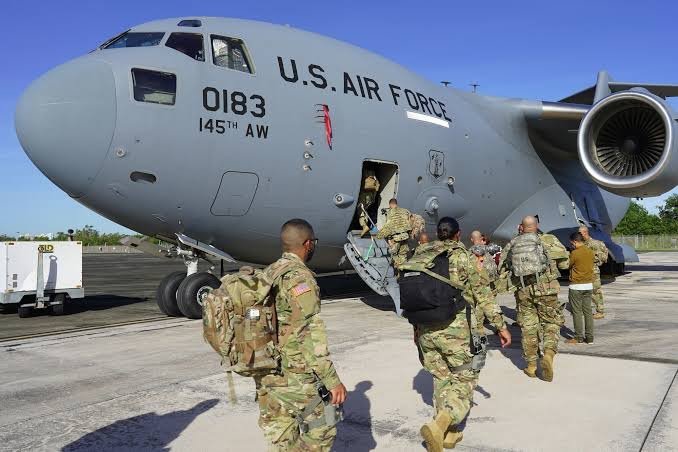
The United States government has announced the deployment of approximately 200 military personnel to Nigeria as part of a strategic security cooperation initiative aimed at strengthening Nigeria’s capacity to combat Islamist militant groups operating within its borders and across the Lake Chad region.
The move, confirmed by U.S. and Nigerian defense sources on Wednesday, signals deepening military collaboration between Washington and Abuja amid ongoing security challenges posed by extremist organizations, including Boko Haram and the Islamic State West Africa Province (ISWAP).
According to officials, the U.S. troops will not engage in direct combat operations but will focus primarily on training, advisory support, intelligence-sharing, and capacity building for Nigerian armed forces.
Strengthening Bilateral Security Cooperation
Defense analysts describe the deployment as part of a broader security partnership framework between the two nations. The United States has, for more than a decade, provided various forms of military assistance to Nigeria, including intelligence support, counterterrorism training, equipment transfers, and joint exercises.
In a statement outlining the mission’s objectives, U.S. defense officials emphasized that the 200 personnel would serve in non-combat roles, working closely with Nigerian military units to enhance operational effectiveness, tactical coordination, and counterinsurgency capabilities.
“The focus is on training, mentoring, and strengthening Nigeria’s ability to independently address extremist threats,” a U.S. official familiar with the deployment said. “This is about partnership and capacity development.”
Nigerian defense authorities welcomed the initiative, describing it as a timely reinforcement of ongoing efforts to restore stability in the country’s northern and northeastern regions.
Persistent Threat of Islamist Militancy
Nigeria has battled Islamist insurgency for over a decade, particularly in the northeast, where Boko Haram launched its violent campaign in 2009. Over the years, the insurgency has evolved, with factions splitting and rebranding, most notably under the banner of ISWAP, which maintains ties to the broader Islamic State network.
The conflict has resulted in tens of thousands of deaths and displaced millions of civilians. Despite sustained military operations under various counterterrorism campaigns, extremist groups continue to stage attacks on military installations, rural communities, and critical infrastructure.
Security experts say that while Nigerian forces have recorded tactical gains in recent years, the insurgency remains resilient due to factors such as porous borders, arms trafficking, socio-economic grievances, and complex terrain in remote regions.
The arrival of U.S. troops for specialized training is expected to focus on advanced counterinsurgency tactics, intelligence coordination, reconnaissance operations, and possibly drone and surveillance technology integration.
Scope of the Training Mission
Although full operational details have not been disclosed, defense insiders indicate that the U.S. contingent will be deployed to designated training facilities rather than frontline combat zones. Activities are expected to include:
- Tactical training in counterterrorism operations
- Intelligence analysis and information-sharing systems
- Counter-improvised explosive device (IED) techniques
- Civil-military coordination strategies
- Logistics and operational planning support
Military cooperation may also extend to enhancing Nigeria’s air-ground coordination, particularly as the country continues to modernize its air force fleet.
Officials stressed that the deployment is temporary and will be reviewed periodically based on mission objectives and evolving security conditions.
Regional Implications
The deployment carries broader regional significance. Nigeria is a key player in the Multinational Joint Task Force (MNJTF), which comprises troops from Nigeria, Chad, Niger, and Cameroon to combat extremist groups around the Lake Chad Basin.
Instability in Nigeria often has spillover effects across West and Central Africa. By strengthening Nigeria’s military capabilities, the United States aims to reinforce collective regional security structures.
Analysts note that Islamist militant networks have increasingly adapted their tactics, exploiting governance gaps and local grievances. Enhanced training and intelligence coordination may help Nigerian forces anticipate and neutralize emerging threats more effectively.
Strategic Interests and Geopolitical Context
The U.S. deployment also reflects broader geopolitical considerations. The Sahel and West African region have witnessed shifting security alliances in recent years, with some countries reassessing traditional partnerships.
Washington has emphasized its commitment to supporting democratic governments and counterterrorism initiatives in Africa, positioning itself as a long-term security partner.
Security observers suggest that the mission may also serve to strengthen diplomatic ties between Nigeria and the United States at a time when global powers are competing for influence across the African continent.
“Nigeria is Africa’s most populous nation and a major economic and strategic hub,” said a geopolitical analyst based in Abuja. “Security collaboration with Nigeria is central to broader U.S. engagement in West Africa.”
Domestic Reactions in Nigeria
Reactions within Nigeria have been mixed. Government officials and military leadership have largely expressed support, citing the benefits of advanced training and technological exchange.
“This collaboration enhances our operational readiness and reflects the trust between both nations,” a senior Nigerian defense official said.
However, some civil society groups and political commentators have raised questions about sovereignty and transparency. Critics have called for clear communication regarding the duration of the deployment, rules of engagement, and oversight mechanisms.
Security experts counter that such partnerships are common in global defense cooperation and do not necessarily imply foreign military control or intervention.
Humanitarian and Civilian Impact
Beyond military strategy, the ongoing insurgency has created one of Africa’s most significant humanitarian crises. Millions of internally displaced persons (IDPs) remain in camps across northeastern Nigeria, relying on government and international aid.
Stability in the region is critical not only for security but also for economic recovery, agricultural production, and community rebuilding efforts.
Counterterrorism training that improves precision operations and minimizes civilian harm could play a role in reducing unintended casualties and rebuilding public trust in security institutions.
A History of U.S.-Nigeria Military Collaboration
The United States has previously supported Nigeria through programs such as counterterrorism training initiatives, joint exercises like African Lion and Flintlock, and equipment transfers under security assistance frameworks.
American advisors have historically provided intelligence support and helped improve maritime security in the Gulf of Guinea, where piracy has also posed threats.
This latest deployment builds on that foundation, reflecting continuity rather than a radical policy shift.
International Law and Operational Boundaries
Officials on both sides emphasized that the U.S. troops will operate strictly within the boundaries of Nigerian law and international agreements governing military cooperation.
The mission is not described as a combat operation but rather as a training and advisory role, distinguishing it from active military interventions seen in other conflict zones.
Pentagon officials clarified that any operational support would remain under Nigerian command authority, reinforcing the principle that Nigerian forces retain full control over their national security operations.
Security Outlook
While the deployment of 200 U.S. troops may not dramatically alter the balance of power overnight, analysts believe it could have long-term benefits if effectively integrated into Nigeria’s broader security strategy.
Counterinsurgency experts stress that military training alone cannot resolve the root causes of extremism. Addressing poverty, unemployment, governance deficits, and community grievances remains essential for lasting peace.
However, improved tactical proficiency, better intelligence coordination, and stronger logistical systems can enhance Nigeria’s ability to contain and degrade militant operations.
Conclusion
The decision by the United States to deploy 200 troops to Nigeria for counterterrorism training marks a significant development in bilateral security cooperation. As Nigeria continues its fight against Islamist militant groups, the partnership underscores shared interests in regional stability and global security.
While the mission is limited in scope and focused on training rather than combat, its implications extend beyond the battlefield—touching on diplomacy, regional alliances, humanitarian concerns, and geopolitical dynamics.
As the deployment unfolds, attention will remain on its effectiveness, transparency, and impact on Nigeria’s broader counterinsurgency efforts. Both nations have framed the initiative as a collaborative step toward strengthening Nigeria’s capacity to secure its territory and protect its citizens from extremist violence.
Further updates are expected as operational details emerge and the training program progresses in the coming months.