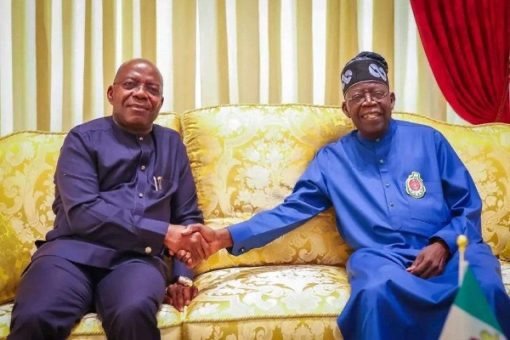
Alex Otti: “I Am Not in a Position to Oppose Tinubu in 2027” — Abia Governor Signals Cautious Political Stance
Abia State Governor, Alex Otti, has said he is not in a position to oppose President Bola Ahmed Tinubu in the 2027 general elections, a statement that is already generating significant attention within Nigeria’s political space as early permutations for the next electoral cycle begin to take shape.
The remark, though brief, carries weight given Otti’s standing as a prominent opposition figure and a sitting governor elected under a party outside the ruling All Progressives Congress (APC). Political observers say the statement reflects a cautious, calculated approach to national politics at a time when alliances and strategies are gradually forming ahead of 2027.
A Statement with Broad Implications
“I am not in a position to oppose President Bola Tinubu’s candidacy come the 2027 general elections,” Otti said, offering no further elaboration but leaving room for multiple interpretations.
While the governor did not explicitly endorse the president, his comment has been widely interpreted as a signal of restraint, suggesting that he may not actively participate in efforts to challenge the incumbent should he seek re-election.
In Nigeria’s political environment, where early positioning often begins years before elections, such a statement is seen as significant, particularly coming from a leader outside the ruling party structure.
Nigeria’s Electoral Context
Nigeria operates a four-year electoral cycle, with the next general elections scheduled for 2027. Incumbent presidents are constitutionally eligible for a second term, and it is widely expected that President Bola Ahmed Tinubu would seek re-election, barring unforeseen circumstances.
Historically, incumbency has played a major role in Nigerian elections, offering advantages such as greater visibility, access to state resources, and broader political networks. As a result, opposition figures often face significant challenges in mounting effective campaigns against sitting presidents.
Governor Otti’s remarks come against this backdrop, highlighting the complexities involved in confronting an incumbent administration.
Otti’s Political Position
Alex Otti emerged as governor of Abia State following the 2023 general elections, marking a shift in the state’s political landscape. A former banker and economist, he campaigned on a platform focused on economic reform, governance transparency, and infrastructural development.
Since assuming office, Otti has emphasized policy-driven governance, with efforts aimed at improving public services and fiscal management within the state.
His position as a governor from an opposition party places him in a unique role within Nigeria’s political ecosystem, balancing state-level governance responsibilities with broader national political considerations.
Interpreting the Statement
Political analysts have offered varying interpretations of Otti’s comments, noting that such statements often carry layered meanings in Nigeria’s political discourse.
One interpretation is that the governor is adopting a pragmatic stance, choosing to avoid early confrontation with the federal government. This approach could be aimed at maintaining a cooperative relationship that may benefit Abia State in terms of federal support and collaboration.
Another perspective suggests that Otti’s remark reflects the reality of Nigeria’s political arithmetic, where challenging an incumbent president requires extensive coalition-building and strategic alignment across multiple parties and regions.
By stating that he is not in a position to oppose the president, Otti may be signaling caution while leaving open the possibility of future political developments.
Implications for Opposition Politics
The statement has also sparked discussions about the state of opposition politics in Nigeria. Opposition parties have historically faced challenges in forming unified fronts capable of competing effectively at the national level.
Fragmentation, internal disputes, and differing strategic priorities have often weakened their ability to present a cohesive alternative to the ruling party.
Otti’s remark may therefore reflect broader uncertainties within opposition ranks as leaders assess their options ahead of the next election cycle.
Some analysts argue that early signals of neutrality or non-opposition could complicate efforts to build strong coalitions, while others see it as a realistic acknowledgment of current political dynamics.
Governance Versus Politics
Another key dimension of Otti’s statement is the balance between governance and politics. As a sitting governor, his primary responsibility is to his state, and engaging in national political battles too early could divert attention from governance priorities.
By adopting a cautious stance, Otti may be seeking to focus on delivering results within Abia State while keeping his options open for future political engagement.
This approach aligns with a broader trend among some state leaders who prioritize development outcomes over early political maneuvering.
Tinubu’s Political Landscape
President Bola Ahmed Tinubu assumed office in 2023 and has since been implementing policies aimed at economic reform, including subsidy removal and fiscal adjustments.
His administration faces both support and criticism, with debates ongoing about the impact of these policies on the economy and citizens’ welfare.
As the 2027 elections approach, the president’s performance in office will likely play a central role in shaping public opinion and determining the strength of any opposition challenge.
Otti’s comments come at a time when these dynamics are still evolving, adding another layer to the national conversation.
Early Signals Ahead of 2027
Although the 2027 elections are still some distance away, political actors have begun making early moves that could influence future alignments.
Statements such as Otti’s are part of a broader pattern in which politicians position themselves strategically, often avoiding definitive commitments while assessing the political environment.
These early signals can shape perceptions, influence negotiations, and set the stage for alliances that may emerge closer to the election.
Public and Political Reactions
Reactions to Otti’s statement have been mixed. Some observers view it as a pragmatic acknowledgment of political realities, while others interpret it as a sign of potential alignment or reluctance to challenge the status quo.
Supporters of the governor argue that his focus should remain on governance and delivering on campaign promises, rather than engaging in premature political contests.
Critics, however, suggest that opposition leaders have a responsibility to provide clear alternatives and challenge incumbents where necessary.
The Road to 2027
As Nigeria moves closer to another electoral cycle, the political landscape is expected to evolve significantly. Alliances may shift, new candidates may emerge, and policy debates will intensify.
Governor Otti’s statement is one of many developments that will shape the narrative leading up to the elections.
For now, it underscores the cautious approach being adopted by some political actors as they navigate a complex and dynamic environment.
Conclusion
The declaration by Alex Otti that he is not in a position to oppose President Bola Ahmed Tinubu in the 2027 general elections highlights the strategic calculations already underway in Nigeria’s political arena.
While the statement stops short of an endorsement, it reflects a measured stance shaped by considerations of governance, political reality, and future possibilities.
As the country approaches the next election cycle, such comments will continue to influence public discourse and provide insight into the thinking of key political figures.
Ultimately, the path to 2027 will be defined not only by statements and positioning but by performance, policy outcomes, and the ability of political actors to connect with the aspirations of the Nigerian people.