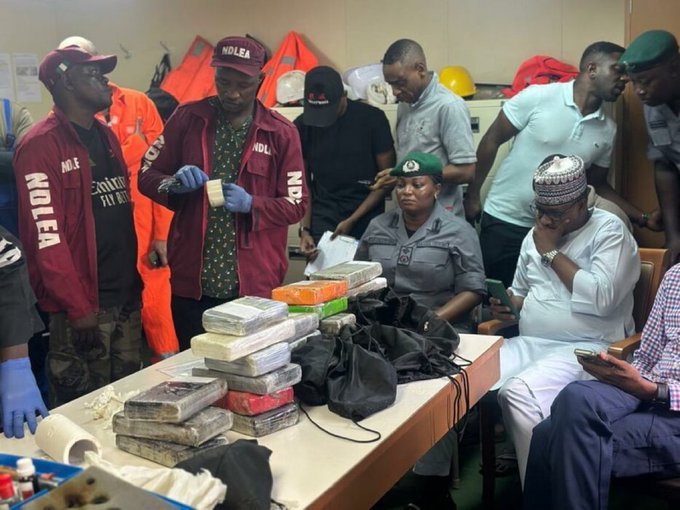
The Nigeria Customs Service (NCS) has recorded another major breakthrough in the nation’s fight against illicit drug trafficking with the seizure of 25.5 kilograms of cocaine at the Apapa Seaport in Lagos State. The illicit consignment was intercepted aboard a vessel that arrived from Brazil, according to preliminary security sources at the nation’s busiest port.
The high-profile seizure, which occurred during a routine but intelligence-driven inspection of inbound cargo, underscores the growing sophistication of drug trafficking networks using Nigeria as a transit and destination point, as well as the renewed resolve of the Nigeria Customs Service to clamp down on transnational organized crime.
Although full operational details are still being compiled, security sources confirmed that the cocaine was discovered during a thorough examination of cargo offloaded from the Brazilian vessel shortly after it berthed at Apapa Port.
Discovery at Nigeria’s Busiest Port
Apapa Port remains Nigeria’s largest and most strategic maritime gateway, handling a significant volume of the country’s international trade. It has also, over the years, been a focal point for attempts by criminal syndicates to smuggle prohibited items into the country.
According to customs officials familiar with the operation, the cocaine seizure followed weeks of intelligence gathering, profiling of high-risk vessels, and enhanced surveillance of shipping routes linking South America to West Africa.
Brazil, in particular, has been identified by global security agencies as one of the major departure points for cocaine shipments originating from South America, where the drug is largely produced.
The Brazilian vessel involved in the latest seizure was reportedly flagged for secondary inspection based on intelligence shared between Nigerian authorities and international partners. During the physical examination of the ship’s cargo, officers uncovered suspicious packages concealed within containers that were initially declared to contain legitimate goods.
After laboratory testing, the substance was confirmed to be cocaine, with a total weight of 25.5 kilograms.
Estimated Street Value and Economic Implications
Although the Nigeria Customs Service has yet to officially disclose the estimated street value of the seized cocaine, drug enforcement experts say 25.5 kilograms of high-grade cocaine could be worth several billions of naira in Nigeria’s illicit drug market.
On the international market, the value would be even higher, running into millions of dollars depending on purity and distribution channels.
The seizure represents a significant financial blow to the criminal networks behind the shipment and highlights the scale of profit that fuels transnational drug trafficking operations.
Beyond the monetary value, authorities stress that intercepting such a large quantity of cocaine also prevents incalculable social damage, particularly among youths who are often the primary targets of drug distribution within the country.
Coordination Among Security Agencies
The operation is understood to be the result of coordinated intelligence and operational efforts between the Nigeria Customs Service, the National Drug Law Enforcement Agency (NDLEA), port security units, and other relevant security agencies operating within the Apapa Port complex.
Such inter-agency collaboration has become increasingly critical in recent years as traffickers adopt more advanced concealment methods and exploit gaps in port security systems.
Senior Customs officers at Apapa described the seizure as a “major strategic success” in the ongoing effort to sanitize Nigeria’s maritime borders and block drug corridors linking South America, West Africa, and Europe.
The NDLEA is expected to take over the investigation, including detailed forensic analysis of the drugs, identification of suspects, and tracing of local and international collaborators.
Suspects and Ongoing Investigation
As of the time of filing this report, no official confirmation had been made regarding arrests linked directly to the seizure. However, sources indicated that several persons connected to the consignment, including some port workers and shipping agents, are currently being questioned by security operatives.
Investigators are working to determine:
- The actual owners of the seized consignment
- The intended recipients within Nigeria or beyond
- The specific concealment method used
- Whether the shipment was part of a larger trafficking ring
- Possible complicity of insiders within the port system
Security officials say the investigation has been broadened to cover both the Nigerian and Brazilian ends of the shipment, with international law enforcement agencies expected to be involved.
Drug Trafficking Routes from South America to West Africa
Over the past two decades, West Africa has increasingly emerged as a major transit hub for cocaine trafficked from South America to Europe and other global markets. The region’s extensive coastline, porous borders, and busy ports make it attractive to international drug cartels.
Nigeria, as West Africa’s largest economy and one of its most important shipping hubs, has been particularly targeted by traffickers.
Brazil, Venezuela, and Colombia remain key source countries for cocaine, while Nigeria serves both as a destination market and a transit point for onward movement to North Africa, Europe, and the Middle East.
Apapa Port, Tin Can Island Port, Onne Port, and airports in Lagos and Abuja have all recorded significant drug seizures in recent years, reflecting the scale of the threat.
Customs’ Renewed War Against Smuggling
The Nigeria Customs Service has, in recent months, intensified its crackdown on smuggling and trafficking of prohibited and harmful goods. Under its current leadership, the Service has prioritized intelligence-led operations, deployment of modern scanning equipment, and closer collaboration with both domestic and international security partners.
Customs officials say the seizure of 25.5kg of cocaine demonstrates the effectiveness of these strategies and the growing professionalism of officers at Nigeria’s ports.
According to security experts, the use of risk profiling, non-intrusive inspection technologies, and real-time intelligence sharing has significantly increased interception rates across the nation’s major entry points.
The Apapa seizure adds to a growing list of major drug interceptions at Nigerian ports and airports over the last two years.
Threat to National Security and Public Health
Authorities have repeatedly warned that drug trafficking poses not only a public health crisis but also a serious national security threat.
Illegal drug proceeds are often used to fund other criminal activities, including terrorism, banditry, kidnapping, arms trafficking, and cybercrime. In many cases, drug syndicates are closely linked to violent criminal networks that destabilize communities and undermine economic development.
Health experts also point out that the rise in cocaine, methamphetamine, and other hard drugs has contributed to an increase in mental health disorders, violent behavior, and social disintegration, especially among young Nigerians.
By intercepting large consignments such as the one seized at Apapa, security agencies believe they are disrupting both the supply chain and the financial backbone of organized crime.
Apapa Port and the Battle for Maritime Security
Apapa Port has long been a strategic yet vulnerable asset in Nigeria’s security architecture. Its heavy cargo traffic, complex logistics chain, and high human activity create both economic opportunities and security challenges.
Over the years, the federal government has invested in port reforms, automation of customs processes, and improved surveillance in a bid to curb corruption, smuggling, and other transnational crimes.
Despite these efforts, criminal networks continue to test Nigeria’s maritime security system with increasingly innovative tactics, including:
- Concealment of drugs within legitimate exports and imports
- Use of false documentation and shell companies
- Collaboration with corrupt insiders
- Trans-shipment through multiple ports to evade detection
The success of the latest seizure suggests that Nigerian authorities are becoming more adept at countering these evolving methods.
Calls for Stiffer Penalties and Judicial Speed
Following the news of the seizure, security analysts and civil society groups have renewed calls for stricter penalties for drug traffickers and faster prosecution of arrested suspects.
Although Nigeria’s drug laws prescribe stiff jail terms for trafficking offenses, many cases drag on for years in the courts, creating room for plea bargains, technical delays, and sometimes outright acquittals.
Legal experts argue that swift and transparent prosecution of suspects arising from the Apapa seizure will send a strong deterrent signal to traffickers who still view Nigeria as a relatively low-risk corridor.
They also emphasize the need to protect investigators and witnesses involved in high-profile drug cases from intimidation and compromise.
Economic and Diplomatic Dimensions
Large-scale drug seizures, especially those linked to international shipping, often carry diplomatic and economic implications. Nigeria’s image in the global trade community can be affected by repeated attempts to use its ports for drug trafficking.
However, successful interceptions by Customs and other agencies also project Nigeria as a serious partner in the global fight against narcotics.
It is expected that Nigerian authorities will engage their Brazilian counterparts through established diplomatic and law enforcement channels to trace the origin of the shipment and dismantle the wider network responsible.
Such cooperation is crucial to addressing the problem at both the source and transit levels.
Public Reactions Across Lagos and Beyond
News of the cocaine seizure has drawn widespread reactions from the public, particularly in Lagos, where concerns about drug abuse and organized crime remain high.
Residents expressed relief that the drugs were intercepted before they could reach the streets, while also calling on authorities to intensify surveillance at all ports and borders.
A Lagos-based transport worker said, “If this quantity had entered the market, it would have destroyed many lives. We commend the officers who carried out this operation.”
Religious leaders and community groups have also urged the government to complement enforcement with stronger drug education and rehabilitation programmes for addicts.
NDLEA Expected to Take the Lead
While Customs made the initial interception, the National Drug Law Enforcement Agency is expected to take full custody of the seized cocaine for further investigation, prosecution, and eventual destruction in accordance with the law.
The NDLEA will also handle forensic profiling of the drugs, chemical analysis to determine purity, and international intelligence sharing to track the syndicate behind the shipment.
This collaboration reflects the standard operational protocol between the two agencies in handling drug-related interceptions at the nation’s ports and borders.
A Major Blow to Transnational Drug Cartels
Security officials describe the seizure of 25.5kg of cocaine at Apapa Port as one of the significant blows dealt to transnational drug cartels in recent times.
The interception not only deprives criminal groups of huge financial profit but also disrupts the distribution chain across multiple countries.
Experts note that replacing such a large consignment is costly and risky for criminal networks, especially in an environment of heightened surveillance.
Looking Ahead
As investigations continue into the Apapa cocaine seizure, Nigerians await official statements from the Nigeria Customs Service and the National Drug Law Enforcement Agency providing detailed updates on arrests, suspects, and next steps in the prosecution process.
Security agencies have assured the public that further operational details will be made available once preliminary investigations are concluded.
For now, the successful interception of 25.5 kilograms of cocaine aboard a Brazilian ship at Apapa Port stands as a powerful reminder of both the persistent threat of transnational drug trafficking and the critical importance of sustained vigilance at Nigeria’s ports.
It also reinforces the message that Nigerian security agencies, when properly coordinated and intelligence-driven, can effectively protect the nation’s borders and shield millions of citizens from the devastating consequences of illicit drugs.