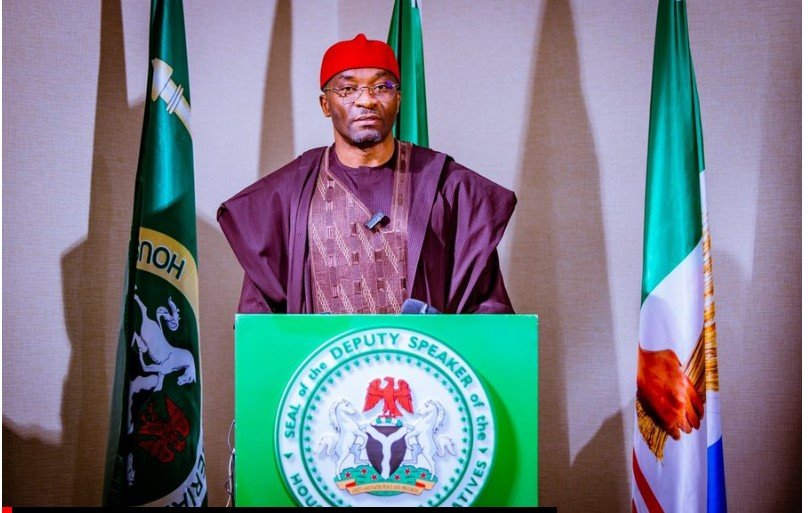
The Deputy Speaker of the House of Representatives, Benjamin Kalu, has commended President Bola Tinubu for implementing what he described as bold and transformative economic reforms that allegedly prevented Nigeria’s economy from collapsing.
Kalu made the remarks as President Tinubu marked three years in office, praising the administration for taking difficult policy decisions aimed at stabilising the nation’s economy despite widespread criticism and public hardship.
The Deputy Speaker also called on Nigerians to support Tinubu’s re-election bid in 2027, arguing that a second term would allow the President to consolidate ongoing reforms and complete critical infrastructure and economic projects initiated by his administration.
President Tinubu was sworn into office on May 29, 2023, succeeding former President Muhammadu Buhari. Since assuming office, the administration has introduced major economic reforms including the removal of fuel subsidy, exchange rate unification, tax restructuring efforts, and initiatives aimed at improving government revenue generation.
Kalu Defends Tinubu’s Economic Policies
According to Kalu, the economic decisions taken by the administration were necessary to rescue Nigeria from deeper financial challenges and restore confidence in the economy.
He stated that although the reforms came with short-term difficulties, they were designed to correct structural distortions that had weakened the nation’s fiscal stability over the years.
The Deputy Speaker noted that previous administrations had delayed confronting difficult economic realities due to fears of political backlash, while Tinubu chose to implement reforms immediately after assuming office.
Kalu argued that the President demonstrated political courage by pursuing policies many leaders avoided despite their economic implications.
Supporters of the administration have consistently maintained that the reforms were necessary to reduce wasteful spending, attract investment, and create a more sustainable economic framework.
Fuel Subsidy Removal Remains Most Controversial Policy
Among the administration’s most significant and controversial policies was the removal of fuel subsidy announced by Tinubu during his inauguration speech in May 2023.
The decision immediately triggered increases in petrol prices across the country, leading to higher transportation costs, inflation, and rising living expenses for millions of Nigerians.
Government officials defended the policy by insisting that fuel subsidy payments had become financially unsustainable and largely benefited corrupt networks involved in fuel importation and smuggling.
According to the administration, trillions of naira previously spent on subsidy payments could instead be redirected toward infrastructure development, healthcare, education, and social welfare programmes.
However, many Nigerians continue to struggle with the economic consequences of the policy, especially rising food prices and transportation fares.
Labour unions and opposition parties have repeatedly criticised the subsidy removal, arguing that ordinary citizens were not adequately protected from its effects.
Exchange Rate Reforms and Economic Challenges
The Tinubu administration also introduced exchange rate reforms aimed at unifying Nigeria’s multiple foreign exchange windows.
The policy was designed to improve transparency in the foreign exchange market, attract foreign investment, and reduce market distortions.
However, the naira experienced significant depreciation following the reforms, contributing to inflationary pressure and increased import costs.
Prices of goods and services rose sharply across different sectors, affecting households and businesses nationwide.
Despite the economic difficulties, government officials insist the reforms are necessary to build a stronger and more competitive economy in the long term.
Economic analysts remain divided over the effectiveness and pace of the reforms.
While some experts believe the policies were unavoidable, others argue that implementation challenges and inadequate social support mechanisms worsened public hardship.
Kalu Calls for Continuity in 2027
The Deputy Speaker urged Nigerians to support Tinubu beyond his current tenure, insisting that continuity would help sustain ongoing projects and reforms.
According to him, major economic transformations require time and consistency to produce visible results.
Kalu argued that interrupting the administration’s policies midway could undermine progress already made in areas such as revenue generation, infrastructure development, energy reforms, and investment promotion.
He stated that Tinubu’s second term would provide an opportunity to consolidate gains and deepen reforms aimed at repositioning the economy.
Political analysts say early conversations surrounding the 2027 election are gradually intensifying as political actors begin positioning themselves ahead of the next electoral cycle.
Although the election remains some distance away, endorsements and political alignments have already started emerging from various groups and individuals.
Mixed Reactions Trail Administration’s Performance
As the Tinubu administration marks three years in office, reactions to its performance remain mixed across the country.
Supporters argue that the government inherited severe economic challenges and has shown determination in addressing long-standing structural problems.
They point to reforms in the oil sector, tax administration, infrastructure development, and public finance management as signs of strategic economic restructuring.
Government officials have also highlighted improvements in revenue generation, increased local refining efforts, and initiatives aimed at boosting agricultural production and investment inflows.
However, critics argue that the reforms have imposed significant hardship on ordinary Nigerians.
Inflation has remained high, with food prices, transportation costs, electricity tariffs, and housing expenses continuing to rise.
Many small businesses and households have struggled with declining purchasing power and rising operational costs.
Opposition parties have accused the administration of implementing policies without adequate social safety measures to cushion their effects.
Calls for Patience Amid Economic Hardship
Despite growing public concern over the cost of living, senior government officials have repeatedly appealed to Nigerians to remain patient with the administration’s reform agenda.
The Federal Government insists that current economic difficulties are temporary and necessary for long-term recovery and stability.
Officials have also announced various intervention programmes including conditional cash transfers, wage awards for workers, student loan initiatives, compressed natural gas transportation projects, and support for state governments.
Economic experts say the success of the reforms will ultimately depend on whether they translate into measurable improvements in employment, inflation control, investment growth, and living standards.
Analysts also stress the importance of strengthening local production, improving security, stabilising electricity supply, and supporting small businesses to drive sustainable economic recovery.
Political Significance of Kalu’s Endorsement
Kalu’s endorsement of Tinubu’s re-election ambition is politically significant given his position within the National Assembly and the ruling All Progressives Congress.
The Deputy Speaker has remained one of the prominent voices defending the administration’s policies and legislative agenda.
Political observers say such endorsements may encourage other political leaders within the ruling party to openly begin mobilising support for Tinubu ahead of 2027.
However, opposition parties are also expected to intensify criticism of the administration’s economic record as political activities gradually gain momentum.
The coming months are likely to witness increased debates over the impact of the administration’s reforms and the broader direction of Nigeria’s economy.
Focus Remains on Economic Recovery
As Nigeria navigates economic reforms and political realignments, many citizens remain primarily concerned about issues affecting daily survival, including inflation, unemployment, insecurity, and the cost of living.
While supporters of the administration view the reforms as necessary steps toward long-term stability, critics insist that the hardship experienced by millions of Nigerians cannot be ignored.
For now, President Tinubu’s administration continues to defend its policies as essential measures aimed at rebuilding the economy and preventing deeper financial instability.
Kalu’s remarks add to growing political support within sections of the ruling party as conversations about governance, reforms, and the 2027 elections continue to shape Nigeria’s political landscape.