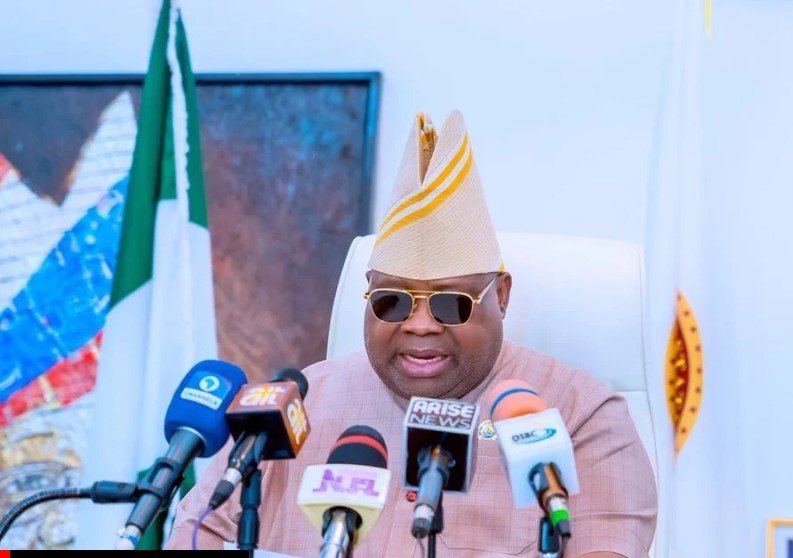
Osun State Governor, Ademola Adeleke, has been declared the winner of the 2026 Osun State governorship election by the Independent National Electoral Commission (INEC), securing a second term in office after defeating his closest challenger, the All Progressives Congress (APC) candidate, Bola Oyebamiji.
Adeleke, who contested the election on the platform of the Accord Party, polled 511,067 votes to emerge victorious in the governorship election held across Osun State on Saturday, August 15, 2026.
The final result was announced by the State Returning Officer for the election, Prof. Joshua Ogunwole, at the INEC collation centre in Osogbo on Sunday morning after results from the state’s 30 local government areas had been collated.
According to the figures announced by INEC, Adeleke defeated Oyebamiji by 66,252 votes. The APC candidate secured 444,815 votes.
The result means Adeleke will remain in office for another term as governor of Osun State, following his victory in the keenly contested election.
Adeleke Wins 19 Local Government Areas
The incumbent governor secured victory in 19 of Osun State’s 30 local government areas, while Oyebamiji of the APC won 11 local government areas.
Adeleke recorded victories in several areas considered politically significant, including Ede North, Ede South, Ejigbo, Iwo, Egbedore, Ife North, Ife East, Ife Central, Oriade, Ifelodun, Orolu, Ayedaade, Ayedire, Odo Otin, Boluwaduro, Ilesa West, Ifedayo, Osogbo and another local government area listed in the final collation.
Oyebamiji, meanwhile, won in Irewole, Isokan, Olorunda, Atakumosa East, Atakumosa West, Ilesa East, Boripe, Irepodun and Obokun, giving the APC candidate victories in 11 local government areas.
The distribution of the results showed that the election was closely contested across the state, but Adeleke maintained a sufficient lead in the overall vote count to secure re-election.
Final Osun Governorship Election Results
The final figures announced by INEC showed that Adeleke of the Accord Party received 511,067 votes, while Oyebamiji of the APC polled 444,815 votes.
The candidate of the African Democratic Congress (ADC), Najeem Salaam, came third with 17,180 votes.
Other candidates recorded significantly smaller totals in the election.
The final result, as reported from the INEC collation exercise, showed 1,010,684 accredited voters and 1,005,800 total votes cast. Of the votes cast, 985,079 were valid, while 20,721 ballots were rejected.
Adeleke’s 511,067 votes represented slightly more than half of the valid votes cast, giving him a clear lead over his nearest challenger.
The margin of victory between Adeleke and Oyebamiji was 66,252 votes, a substantial difference that established the Accord Party candidate as the clear winner once the state-wide results were collated.
Returning Officer Declares Adeleke Winner
The declaration followed the completion of the collation of results from all 30 local government areas of Osun State.
The returning officer formally declared Adeleke the winner after the results had been presented and party agents had signed the relevant documents.
The declaration effectively concluded the official electoral process for the governorship contest, subject to any legal challenges that may subsequently arise.
INEC’s declaration returned Ademola Nurudeen-Jackson Adeleke as governor-elect of Osun State for another term.
The announcement was made at about 7:24 a.m. on Sunday, following several hours of collation that began in the early hours of the day. Reports indicated that the final collation process began at about 2 a.m. and continued until the declaration was made.
Adeleke Defeats APC Challenger
The 2026 Osun governorship election was largely framed as a contest between the incumbent Adeleke and Oyebamiji, the APC candidate.
Adeleke entered the election seeking to retain control of the state, while Oyebamiji campaigned on the platform of the APC with the objective of taking over the Osun Government House.
The final figures showed that Adeleke successfully defended his position, winning more votes statewide and taking control of 19 local government areas.
Oyebamiji’s 444,815 votes, although significant, were not enough to overcome Adeleke’s lead.
The result is also politically significant because the election was one of the major governorship contests ahead of the wider political activities expected to intensify across Nigeria as the country approaches the 2027 general elections.
Osun Election Attracted Significant Voter Participation
The election recorded more than one million accredited voters, reflecting significant participation by registered voters across the state.
INEC figures released ahead of the election indicated that Osun had more than 2.3 million registered voters, making the state one of the important electoral battlegrounds in the South-West.
The election was conducted across the state’s 30 local government areas and 3,763 polling units, with political parties deploying agents to monitor voting, counting and the subsequent collation process.
Available election data showed that more than one million voters were accredited for the exercise.
The relatively high number of votes recorded by the two leading candidates demonstrated the competitiveness of the contest and the strong mobilisation undertaken by the major political parties.
Adeleke’s Second-Term Victory
Adeleke’s victory gives him another opportunity to continue implementing his administration’s policies and programmes in Osun State.
The governor’s political journey in Osun has attracted significant attention since he first won the governorship election in 2022.
His latest victory strengthens his political position in the state and gives the Accord Party control of the Osun Government House for another term.
The election also marks another important chapter in Adeleke’s political career, particularly because of the high-profile nature of the contest and the presence of the APC as the main opposition force.
The outcome is expected to have implications for the political structure of Osun State and the wider South-West political landscape.
APC Records Strong Showing Despite Defeat
Although Oyebamiji lost the election, his performance demonstrated that the APC maintained substantial electoral support across Osun.
The APC candidate secured 444,815 votes, finishing more than 66,000 votes behind Adeleke.
Oyebamiji also won 11 local government areas, including several areas across the state, showing that the APC remained a significant political force.
The results from the election are therefore likely to shape political strategies in Osun ahead of future elections, particularly as parties begin positioning themselves for the 2027 general elections.
ADC Candidate Finishes Third
The African Democratic Congress candidate, Najeem Salaam, finished third with 17,180 votes.
Although his total was considerably lower than those of Adeleke and Oyebamiji, the ADC emerged as the third-largest vote recipient in the governorship contest.
Other political parties participating in the election recorded smaller vote totals, highlighting the dominance of the Accord Party and APC in the statewide contest.
What Adeleke’s Victory Means for Osun
The re-election of Adeleke means that Osun voters will continue with the administration for another term rather than experiencing a change of government.
The governor is now expected to focus on consolidating his administration’s policies while addressing issues affecting residents across the state.
Key areas likely to remain important to the administration include infrastructure, education, healthcare, workers’ welfare, agriculture, security, economic development and local government administration.
The election result also places greater responsibility on the returning administration to deliver on campaign promises and respond to the expectations of voters who supported it.
For the opposition, the result provides an opportunity to review its campaign strategy, electoral performance and mobilisation ahead of future elections.
Election Result Signals Continued Political Competition
The Osun governorship election has once again demonstrated the competitive nature of elections in the state.
With Adeleke winning 19 local government areas and Oyebamiji taking 11, the results reflected a strong two-party contest despite the participation of several other political parties.
The 66,252-vote margin ultimately gave Adeleke a decisive statewide victory.
The declaration by INEC has now formally settled the outcome of the August 15 governorship election, with Adeleke returned as the winner.
The election also provides an early indication of the political dynamics that could influence the South-West region as Nigeria moves closer to the 2027 general elections.
Adeleke Calls for Unity After Victory
Following his declaration, Adeleke described the outcome as a victory for democracy and the people of Osun State.
The governor also expressed appreciation to voters and indicated his expectation that his main challenger would accept the result and congratulate him.
His comments pointed towards reconciliation following a competitive campaign and election.
The governor’s re-election means he will have another term to pursue the policies of his administration and work with stakeholders across the state.
For Osun residents, attention will now shift from the election campaign to governance, service delivery and the implementation of the promises made during the election period.
Conclusion
The 2026 Osun governorship election has ended with Governor Ademola Adeleke of the Accord Party declared winner by INEC.
Adeleke secured 511,067 votes, defeating APC candidate Bola Oyebamiji, who polled 444,815 votes, by 66,252 votes.
The incumbent governor won 19 of the state’s 30 local government areas, while Oyebamiji won 11. The ADC candidate, Najeem Salaam, finished third with 17,180 votes.
With the official declaration by INEC, Adeleke has been returned for another term as governor of Osun State.
The result brings an end to the 2026 Osun governorship contest and begins a new phase in which the governor will be expected to translate his electoral victory into improved governance and development across the state.
The election’s outcome is also likely to remain politically significant beyond Osun, particularly as political parties and their candidates begin preparations for Nigeria’s next major electoral cycle.
For now, the official result is clear: Ademola Adeleke has won the 2026 Osun State governorship election and will continue as governor for another term.