Nigeria is intensifying efforts to reduce its dependence on imported military equipment as the Defence Industries Corporation of Nigeria (DICON), through its partnership with D7G Limited, advances plans to expand local production of armoured vehicles, anti-drone systems and other specialised defence platforms.
The initiative is part of the Federal Government’s broader push to strengthen Nigeria’s indigenous defence-industrial capacity, improve technology transfer and ensure that the Armed Forces can increasingly rely on locally produced equipment to respond to the country’s security challenges.
The latest development follows engagements involving DICON-D7G, the joint venture between the Defence Industries Corporation of Nigeria and D7G Limited, and international defence manufacturers.
DICON and D7G formally signed a Memorandum of Understanding in January 2024 to establish a joint venture aimed at meeting the defence requirements of the Nigerian Armed Forces and other security agencies. DICON said the partnership was established in line with the mandate to develop Nigeria’s military-industrial complex and provisions of the DICON Act 2023. (Dicon)
The collaboration has since evolved into a wider programme involving the production, assembly, maintenance and distribution of defence equipment in Nigeria.
According to information provided by DICON-D7G, the partnership is intended to facilitate technology transfer and build production capabilities that could eventually enable Nigeria to supply defence equipment to other African countries.
DICON-D7G Targets Indigenous Defence Production
The renewed push for local production comes at a time when Nigeria continues to face significant security challenges, including terrorism, banditry, kidnapping and other forms of asymmetric warfare.
These threats have placed sustained demands on the Nigerian military and other security agencies, increasing the need for reliable access to armoured vehicles, weapons, surveillance systems, counter-drone technologies and other specialised equipment.
For decades, Nigeria has relied heavily on foreign suppliers for many categories of military hardware.
While international procurement remains an important component of military modernisation, the Federal Government has increasingly sought to develop domestic capacity to manufacture, maintain and repair critical equipment.
DICON-D7G is one of the initiatives being positioned to support that objective.
The company has described its mandate as encompassing the manufacture, assembly, marketing, distribution and export of military-industrial products, including armoured vehicles, ammunition, weapons systems, surveillance equipment and other defence-related technologies. (D7G)
The partnership also has the potential to reduce the time required to obtain spare parts and equipment, particularly during prolonged military operations when dependence on overseas suppliers can create logistical challenges.
Partnership With Egyptian Defence Manufacturer
The latest plans include cooperation with Eagles International for Defence Systems, an Egyptian defence manufacturer specialising in armoured vehicles and related protection systems.
The company operates manufacturing facilities in Egypt and has exhibited its products at major defence exhibitions. Its stated business focus includes armoured vehicles for military and civilian applications. (Eagles Flight Dispatch)
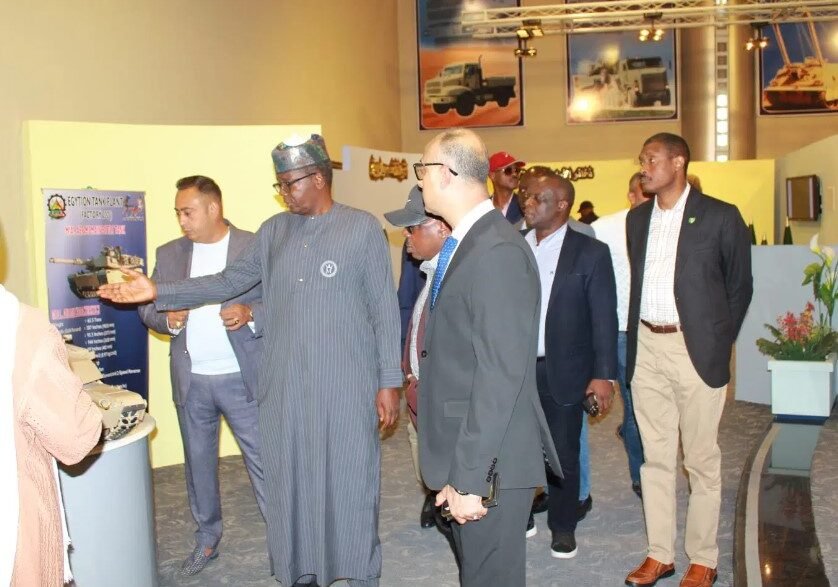
A Nigerian delegation led by the Minister of State for Defence, Dr Bello Mohammed Matawalle, reportedly inspected defence production facilities in Cairo as part of efforts to assess technologies and platforms that could be considered for local manufacturing.
The inspection was aimed at examining production systems and determining how appropriate technologies could be transferred and adapted to Nigeria’s defence-industrial requirements.
The proposed arrangement is not simply about importing additional vehicles into Nigeria. The stated objective is to establish production capacity that allows some of the platforms to be manufactured or assembled domestically.
That distinction is important because local assembly and manufacturing can create opportunities for Nigerian engineers, technicians, fabricators and other specialists to participate directly in the defence supply chain.
Armoured Vehicles Among Key Targets
Among the platforms identified for potential local production are several armoured vehicles and specialised military cabins.
The proposed portfolio includes the Armoured Multi-Purpose Vehicle BR6, Armoured Personnel Carrier cabins, 120mm manual mortar launcher cabins, medical evacuation cabins and ambulance cabins.
Other platforms identified include the MRAP Buffalo U.10 and M.12, MRAP-Buffalo F-4, Rhino Guard GXR anti-drone and RPG-protected vehicle, APC Moon PT6, GXR Phantom light vehicle and BMP-2 Infantry Fighting Vehicle.
The inclusion of mine-resistant ambush-protected vehicles is particularly relevant to Nigeria because of the threats posed by improvised explosive devices, ambushes and attacks on military convoys.
MRAP-type vehicles are designed to provide increased protection to personnel against mines, improvised explosive devices and ballistic threats.
Similarly, specialised medical evacuation and ambulance platforms could improve the ability of military units to evacuate wounded personnel from operational areas.
The proposed production of such vehicles locally could therefore support both combat operations and military logistics.
Anti-Drone Capability Gains Importance
Another important element of the proposed defence production programme is the development of anti-drone capability.
The Rhino Guard GXR has been identified among the platforms under consideration and is described as incorporating protection against rocket-propelled grenade threats and counter-drone capabilities.
The growing use of drones in modern warfare has significantly changed battlefield dynamics.
Unmanned aerial systems can be used for surveillance, reconnaissance, targeting and, in some cases, attacks.
For Nigeria, the development of effective counter-drone capabilities has become increasingly important as armed groups and other hostile actors seek access to commercially available and modified unmanned systems.
Developing local capacity in this area could help the Armed Forces respond more quickly to emerging technological threats.
It could also allow Nigerian defence engineers to modify systems according to specific operational requirements.
Technology Transfer at the Centre of the Initiative
Technology transfer is one of the most important aspects of the DICON-D7G strategy.
Rather than relying exclusively on the importation of complete military platforms, the partnership is designed to provide Nigeria with access to manufacturing knowledge, engineering processes and technical expertise.
This could gradually allow Nigerian personnel to take responsibility for more stages of the production cycle.
The long-term objective is to move from assembly and licensed production towards greater domestic design, engineering, maintenance and manufacturing capability.
D7G has previously stated that its partnership with DICON is intended to establish Nigeria as a hub for defence production, assembly and maintenance serving both Nigeria and other African countries. (D7G)
The company has also highlighted the role of engineering graduates and computer scientists in developing indigenous defence technologies and reverse-engineering capabilities.
Job Creation for Retired Military Personnel
The proposed expansion is also expected to create employment opportunities.
According to the plans outlined by DICON-D7G, the initial phase of the collaboration is expected to create more than 200 jobs, while providing opportunities for about 100 retired military personnel whose operational and technical experience could be deployed in the emerging defence manufacturing sector.
The use of retired military personnel could provide manufacturers with access to people who understand military equipment, operational requirements, maintenance procedures and the practical challenges faced by soldiers in the field.
Rather than allowing experienced personnel to leave the defence ecosystem completely after retirement, the initiative could provide a pathway for them to contribute to military production and training.
D7G has previously highlighted employment for retired military officers and personnel as part of its domestic defence production strategy. (The Nation)
Nigeria Already Producing Some Defence Equipment Locally
The proposed armoured vehicle programme builds on other developments in Nigeria’s domestic defence industry.
DICON-D7G has already moved into local production of small arms.
In 2025, the organisation announced the production of the DG-103 rifle, an upgraded version of the AK-103, with the company reporting that nearly 1,000 units had been assembled within two months of production beginning.
The company also announced plans to develop significant domestic ammunition production capacity. (Punch Newspapers)
These developments indicate that Nigeria’s ambition extends beyond assembling armoured vehicles and includes the development of a broader defence manufacturing ecosystem.
A successful industrial base would require manufacturers capable of producing weapons, ammunition, vehicles, electronics, communications systems, spare parts and other components.
Military Jetty Planned for Lagos
Beyond production facilities, DICON-D7G has also been pursuing plans for a dedicated military jetty in Lagos.
The proposed facility is intended to strengthen the logistics infrastructure supporting Nigeria’s defence-industrial sector.
A military jetty could provide a strategic route for moving raw materials, components and finished military equipment by sea.
It could also support the eventual export of Nigerian-made defence products to other African countries.
Previous reports on the project have described the proposed facility as incorporating space for defence equipment production, assembly and storage, with the wider project expected to support substantial employment. (Vanguard News)
The logistics component is important because manufacturing defence equipment requires more than factories.
Raw materials have to be transported to production facilities, components need to move between suppliers and factories, and completed platforms must eventually reach military formations or export markets.
An integrated logistics network could therefore improve the efficiency of the emerging defence-industrial ecosystem.
Economic Benefits of Local Defence Manufacturing
The Federal Government’s push for domestic military production also has potential economic benefits.
Nigeria spends substantial amounts on defence equipment and military-related procurement.
Increasing the proportion of defence expenditure that goes to domestic manufacturers could help retain more economic value within the country.
Local production could create demand for steel, engineering services, electronics, vehicle components, machining, software, logistics and other supporting industries.
It could also encourage universities, technical institutions and research centres to develop programmes focused on defence engineering and related technologies.
Over time, this could produce a wider industrial ecosystem in which military procurement contributes to technological development beyond the Armed Forces.
Reducing Foreign Supply Vulnerabilities
Another major benefit of indigenous defence production is supply security.
Military operations can continue for months or years, creating continuous demand for ammunition, spare parts, tyres, engines, communications equipment, protective systems and other supplies.
Where a country depends entirely on overseas suppliers, geopolitical developments, export restrictions, shipping disruptions or delays in international procurement can affect the availability of critical equipment.
Local manufacturing cannot eliminate those risks entirely because many advanced components may still have to be sourced internationally.
However, developing domestic capacity can reduce dependence on external suppliers for selected categories of equipment.
It can also improve the military’s ability to repair and maintain platforms without sending major components abroad.
Potential for African Defence Exports
DICON-D7G has also identified the African market as a potential destination for Nigerian-made defence products.
Nigeria is Africa’s most populous country and has one of the continent’s largest economies and military establishments.
If local manufacturers can achieve internationally recognised standards while producing equipment at competitive prices, Nigeria could potentially develop a role as a regional supplier of selected defence products.
D7G has previously stated that its ambition is for other African countries to patronise products emerging from the Nigerian defence-industrial complex. (Dicon)
Such exports could generate foreign exchange, create additional industrial jobs and strengthen Nigeria’s position in the African security sector.
However, achieving that objective would require sustained investment, quality control, reliable production capacity, certification and compliance with applicable national and international regulations.
Government Push for Defence Self-Reliance
The DICON-D7G programme forms part of a broader government effort to strengthen Nigeria’s defence-industrial base.
Defence Minister of State Bello Matawalle has repeatedly expressed support for greater domestic production and reduced reliance on foreign manufacturers.
In 2026, Matawalle publicly commended DICON-D7G for showcasing Nigerian defence products internationally and described local manufacturing as part of efforts to reduce Nigeria’s dependence on international defence manufacturers. (Trending News)
The company has also participated in international defence exhibitions, including events in Doha and Istanbul, where Nigerian defence capabilities and products were presented to international audiences.
Such participation provides opportunities for Nigerian defence companies to establish partnerships, identify technologies and potentially access foreign markets.
Challenges Ahead
Despite the potential benefits, building a sustainable defence-manufacturing industry will require substantial investment and long-term planning.
Manufacturing sophisticated armoured vehicles and counter-drone systems requires specialised machinery, skilled engineers, reliable electricity, quality raw materials and strong research and development capacity.
The industry will also need consistent government procurement policies that give local manufacturers enough demand to justify continued investment.
Quality assurance will be particularly important because military equipment operates in demanding environments where manufacturing defects can have serious consequences.
Nigeria will also need to develop deeper local supply chains so that manufacturers are not simply importing most of the components and assembling them domestically.
The ultimate test of the initiative will therefore be how much genuine Nigerian industrial value is created at each stage of production.
A Strategic Shift in Nigeria’s Defence Policy
The expansion of DICON-D7G represents a potentially important shift in Nigeria’s approach to military procurement.
For years, foreign procurement has played a central role in equipping the Armed Forces. The emerging strategy seeks to complement international purchases with domestic manufacturing, assembly, maintenance and technology development.
The objective is not necessarily to eliminate foreign procurement but to reduce excessive dependence on it.
If successfully implemented, the strategy could provide Nigeria with greater control over critical aspects of its defence supply chain while simultaneously creating industrial and employment opportunities.
The development also aligns with the wider objective of building a defence industry capable of supporting the military during prolonged security operations.
Conclusion
Nigeria is stepping up efforts to build a stronger indigenous defence manufacturing industry, with DICON-D7G advancing plans for local production of armoured vehicles, specialised military platforms and counter-drone systems.
The partnership between the Defence Industries Corporation of Nigeria and D7G Limited was formalised through a 2024 MoU aimed at developing a military-industrial complex capable of meeting the requirements of the Nigerian Armed Forces and other security agencies. (Dicon)
The collaboration with Eagles International for Defence Systems could provide additional access to armoured vehicle technologies and manufacturing expertise.
Platforms identified for potential local production include the Armoured Multi-Purpose Vehicle BR6, APC cabins, mortar launcher cabins, medical evacuation and ambulance cabins, MRAP Buffalo variants, Rhino Guard GXR, APC Moon PT6, GXR Phantom and BMP-2 Infantry Fighting Vehicle.
The initiative also includes plans to strengthen Nigeria’s defence logistics infrastructure through a proposed military jetty in Lagos.
Beyond military capability, the programme could generate jobs, create opportunities for retired military personnel, strengthen technical skills, stimulate local industries and potentially position Nigeria as a supplier of selected defence equipment to other African countries.
Nigeria’s security environment makes the development particularly important. Terrorism, banditry, kidnapping and other asymmetric threats require sustained access to dependable military equipment.
The success of the initiative, however, will depend on sustained investment, technology transfer, quality control, skilled manpower and the development of genuine domestic supply chains.
If those conditions are met, DICON-D7G’s expansion could become an important component of Nigeria’s long-term effort to move from being predominantly a buyer of military equipment to a country capable of designing, manufacturing, maintaining and eventually exporting critical defence systems.