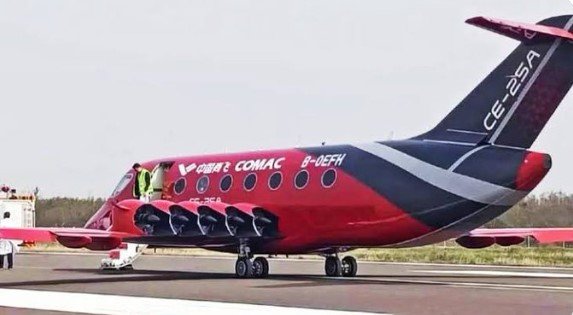
The 10-tonne aircraft, developed by the Commercial Aircraft Corporation of China (COMAC), completed its maiden crewed flight on Saturday, November 14, 2026, in Binzhou, Shandong Province, eastern China.
The aircraft carried two pilots and a flight-test engineer during the historic test, which COMAC described as successful, with its performance indicators meeting expectations.
Designed primarily for short-distance commercial and regional journeys between cities, the CE-25A has a maximum take-off weight of 10 tonnes, a cruising speed of 300 kilometres per hour and an estimated range of 400 kilometres.
The aircraft can accommodate up to 19 passengers, potentially offering a new option for regional transportation as China continues to invest in electric aviation and advanced aerospace technologies.
The successful flight is particularly significant because the aircraft had previously demonstrated its ability to fly autonomously without pilots on board.
According to information released by Chinese state media and COMAC, the CE-25A completed its first unmanned autonomous flight on February 2, 2026, before undergoing a series of additional flight validations.
The latest crewed flight represents another important stage in the aircraft’s development as its manufacturer works towards securing the necessary regulatory approvals for commercial operations.
The development has attracted international attention because electric passenger aircraft have long been viewed as a potential alternative to conventional aviation, particularly for shorter routes where battery-powered technology could offer operational advantages.
China Conducts First Piloted Flight of CE-25A Electric Aircraft
The maiden piloted flight took place in Binzhou, a city in China’s eastern Shandong Province, on November 14.
During the test, two pilots and a flight-test engineer boarded the aircraft to evaluate its performance under crewed operating conditions.
According to reports citing COMAC, the aircraft operated normally throughout the flight, with its major performance indicators meeting expectations.
The test lasted 57 minutes and 46 seconds, including ground operations, while the aircraft remained airborne for 16 minutes and 38 seconds.
It covered approximately 60.4 kilometres during the flight.
The successful operation followed months of development and testing aimed at assessing the aircraft’s electric propulsion system, flight controls and overall performance.
The CE-25A is particularly notable because it is COMAC’s first electric commercial aircraft.
The company is best known internationally for developing conventional commercial passenger aircraft, including China’s C919 narrow-body jet.
With the CE-25A, the manufacturer is expanding into battery-powered commercial aviation, a sector attracting growing investment from aerospace companies and technology firms around the world.
The aircraft is designed to serve routes connecting cities located within relatively short distances, rather than compete directly with conventional long-distance passenger aircraft.
Its development also reflects China’s broader ambitions to strengthen its position in emerging aviation technologies.
CCTV English+2
Aircraft Can Carry 19 Passengers and Travel 400 Kilometres
One of the most significant features of the CE-25A is its capacity to transport up to 19 passengers using an entirely electric propulsion system.
The aircraft has a maximum take-off weight of approximately 10 tonnes and a reported cruising speed of 300 kilometres per hour.
Its stated range is 400 kilometres, making it suitable for short regional and intercity routes.
Its main specifications include:
Aircraft name: CE-25A.
Manufacturer: Commercial Aircraft Corporation of China (COMAC).
Passenger capacity: Up to 19 passengers.
Maximum take-off weight: 10 tonnes.
Cruising speed: 300 kilometres per hour.
Maximum stated range: 400 kilometres.
Cruising altitude: Approximately 2,400 metres.
Propulsion: Electric ducted-fan system.
First autonomous flight: February 2, 2026.
First piloted flight: November 14, 2026.
The 400-kilometre range is particularly important because it places the aircraft in the category of short-distance regional transportation.
For example, it could potentially serve routes connecting nearby cities without requiring conventional jet aircraft.
However, the actual commercial routes, passenger schedules and operational costs have not yet been announced.
The reported range should also be understood as a design specification, not a guarantee that the aircraft can carry its maximum passenger load over every 400-kilometre journey under all operating conditions.
Factors such as weather, battery performance, payload and operational reserves will influence its practical range.
CE-25A Has Already Completed Autonomous Flights Without Pilots
Another remarkable feature of the Chinese aircraft is its autonomous flight capability.
Before completing its first piloted flight, the CE-25A had already demonstrated its ability to operate without pilots on board.
According to COMAC, the aircraft completed its first unmanned autonomous flight on February 2, 2026.
It subsequently completed 19 unmanned flight validations as part of its development programme.
These tests were conducted to assess the aircraft’s flight performance, reliability and autonomous operating systems before progressing to crewed flight testing.
The autonomous capability is an important part of the aircraft’s technological development.
However, the successful unmanned tests do not mean the aircraft has already been approved to transport passengers commercially without pilots.
Its autonomous flight capability remains part of the development and testing programme, while regulatory authorities must still assess the aircraft’s safety and operational requirements.
The November 14 flight was particularly important because it demonstrated the aircraft’s performance with a human crew on board.
The combination of autonomous and crewed testing represents a major development milestone for the project.
CCTV English+2
How China’s Electric Passenger Aircraft Works
Unlike conventional passenger aircraft powered by jet engines or traditional propeller systems, the CE-25A uses an electric ducted-fan propulsion arrangement.
The aircraft has multiple electrically powered fans positioned along its wings.
The system uses electric motors to drive the fans, generating the thrust required to propel the aircraft through the air.
Reports on the aircraft’s design indicate that it uses 10 electric ducted fans, arranged across its wings.
This distributed propulsion configuration is one of the distinctive features of the CE-25A.
Rather than relying on a conventional arrangement of large jet engines, the aircraft distributes its propulsion system across multiple electric units.
The design is intended to support efficient electric flight and represents a different approach to powering commercial passenger aircraft.
However, the long-term performance of the system will depend on battery technology, energy consumption, maintenance requirements and the aircraft’s ability to meet aviation safety standards.
COMAC has not publicly disclosed all the technical details of the battery system powering the aircraft.
COMAC Partners With CATL and Shanghai Jiao Tong University
The development of the CE-25A involved cooperation between several major Chinese industrial and academic institutions.
COMAC worked with battery manufacturer Contemporary Amperex Technology Co. Limited (CATL), Shanghai Jiao Tong University and other partners on the project.
CATL is particularly important to the development because battery technology remains one of the biggest challenges facing electric aviation.
Unlike electric cars, passenger aircraft require substantial amounts of energy to remain airborne while carrying passengers, luggage and other equipment.
Developing batteries that are sufficiently powerful, lightweight, reliable and safe is therefore essential to making electric commercial aviation practical.
CATL’s involvement brings battery manufacturing and research expertise to the project, while Shanghai Jiao Tong University contributes academic and engineering capabilities.
The collaboration demonstrates how China’s aerospace industry is combining aviation manufacturing, battery technology and university research to develop new forms of transportation.
CCTV English+2
China Begins Aircraft Certification Process
Despite the successful piloted flight, the CE-25A has not yet received final approval for commercial passenger operations.
The Civil Aviation Administration of China (CAAC) has accepted COMAC’s application for a type certificate.
A type certificate is an important regulatory approval confirming that an aircraft design meets the applicable airworthiness requirements.
The certification process involves detailed assessments of an aircraft’s design, engineering, performance and safety systems.
For the CE-25A, completing this process will be necessary before the aircraft can enter regular commercial passenger service.
The aircraft’s designation also reflects its intended certification category.
According to reports, the number 25 in CE-25A refers to China’s Part 25 airworthiness standards, which apply to transport-category aircraft.
This means the development is not simply about demonstrating that an electric aircraft can fly.
It must also satisfy the safety requirements expected of commercial passenger transportation.
COMAC has not announced a confirmed date for the aircraft’s entry into commercial service.
QCAA+2
What the Aircraft Could Mean for Regional Air Travel
The development of the CE-25A could have implications for the future of short-distance air transportation.
Many regional routes involve relatively short journeys between cities, where passengers may benefit from smaller aircraft designed specifically for such distances.
A 19-seat electric aircraft could potentially provide transportation between communities that do not generate enough passenger demand to justify operating larger conventional passenger aircraft.
Its electric propulsion system could also offer advantages in energy efficiency and local emissions compared with conventional fossil-fuel-powered aircraft.
However, these potential benefits will depend on the aircraft’s eventual operating costs, battery replacement requirements, electricity sources, charging infrastructure and maintenance arrangements.
Airports and operators would also need suitable facilities to support electric aircraft operations.
Battery charging times, energy availability and the ability to maintain reliable flight schedules will be important considerations.
Consequently, the CE-25A’s successful flight is an important technological achievement, but commercial viability will require more than successful test flights.
China Strengthens Its Position in Future Aviation Technology
China’s development of the CE-25A comes amid growing international competition to develop electric and autonomous aircraft.
Companies and research institutions in several countries are investing in technologies designed to make aviation more efficient and reduce dependence on conventional aviation fuels.
China has also been expanding its ambitions in what it describes as the low-altitude economy, which includes drones, autonomous aircraft, electric air taxis and other emerging aviation services.
COMAC’s entry into electric commercial aircraft development represents another part of that broader industrial strategy.
The company is already working to establish China’s presence in conventional commercial aircraft manufacturing through programmes such as the C919.
The CE-25A provides an opportunity to explore a different market segment involving smaller, battery-powered passenger aircraft.
Its partnership with CATL and other research institutions also highlights the growing relationship between China’s battery industry and aerospace manufacturing.
Nevertheless, the aircraft will have to demonstrate long-term reliability, obtain regulatory certification and prove that it can operate economically before its full commercial potential can be assessed.
Conclusion
China’s CE-25A has taken an important step towards the future of electric aviation after completing its first piloted flight with two pilots and a flight-test engineer on board.
With a capacity of 19 passengers, a maximum take-off weight of 10 tonnes, a cruising speed of 300 kilometres per hour and a stated range of 400 kilometres, the aircraft has been designed primarily for short regional and intercity journeys.
Its earlier autonomous flights also demonstrate China’s progress in developing aircraft capable of operating without onboard pilots during testing.
However, the aircraft still needs to complete the necessary regulatory certification process before it can begin carrying paying passengers.
If it successfully passes the remaining tests and obtains approval, the CE-25A could become an important development in the global transition towards electric passenger aviation.
For now, its maiden piloted flight represents a significant achievement for COMAC and China’s expanding aerospace industry.