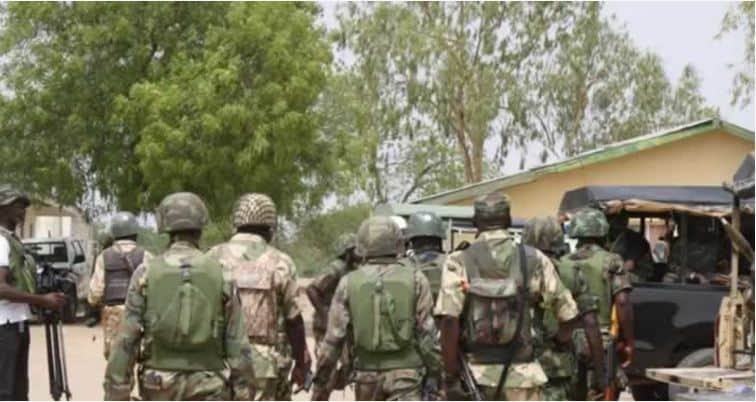
In a daring overnight assault, fighters of the Islamic State West Africa Province (ISWAP) launched a deadly attack on a Nigerian military base in Borno State, leaving many soldiers feared dead and others wounded. The strike, which occurred in the early hours of Friday, is the latest in a series of violent offensives that have rocked the northeastern region.
The Attack: What Happened
According to credible military and local sources, the insurgents stormed a super camp in Ngamudu, located along the Maiduguri–Damaturu highway in Kaga Local Government Area, at around 2:00 a.m. Witnesses said the attackers arrived in large numbers, firing heavy weapons and rocket-propelled grenades, catching the soldiers by surprise.
“The terrorists came around 2:00 a.m. and started shooting sporadically. The exchange of gunfire lasted for over an hour, and many soldiers may have lost their lives,” a security source said.
Wounded troops were immediately evacuated to the Damaturu Specialist Hospital, while reinforcements were dispatched to the area. However, security operatives temporarily blocked the Maiduguri–Damaturu highway to restrict civilian movement and secure the zone.
Casualties and Damage
As of press time, the Nigerian Army has not issued an official statement regarding the number of casualties, but military insiders and local sources confirm that several soldiers were killed or injured during the confrontation.
Reports indicate that reinforcement troops ran into landmines planted by the terrorists along the route to the base, which further delayed their advance and may have resulted in additional losses. The scale of destruction at the camp remains unclear, but sources say heavy military equipment and vehicles were damaged.
Security analysts suggest that the militants may have aimed to overrun the base and loot weapons, a common tactic used in previous ISWAP attacks on military positions across Borno and Yobe States.
ISWAP’s Evolving Tactics
The Ngamudu attack reflects ISWAP’s continued evolution from guerrilla-style ambushes to direct, coordinated assaults on fortified military bases. Over the past year, the group has intensified operations in the Lake Chad Basin and surrounding areas, targeting army formations, police outposts, and strategic roads.
Earlier in 2025, ISWAP fighters attacked the 153 Task Force Battalion base in Marte, killing several soldiers and seizing military hardware. In March, coordinated assaults on two army bases in Borno resulted in multiple casualties and extensive damage.
The frequency of these attacks shows that despite ongoing military campaigns, ISWAP remains well-organized, heavily armed, and determined to destabilize the region.
The Military’s Response
Following Friday’s attack, the Nigerian Army reportedly mobilized reinforcement teams from nearby formations in Benishek and Mainok to the area. However, their movements were slowed by landmines and the blocked highway.
Air Force surveillance aircraft were also sighted hovering over the Ngamudu axis on Friday morning, as part of an effort to track fleeing militants. Although the military has not released details of its counteroffensive, security experts expect air and ground operations to follow in the coming days.
Authorities have also increased patrols along the Maiduguri–Damaturu route, one of the busiest roads in the northeast, to prevent further ambushes and reassure civilians.
Strategic and Security Implications
The attack highlights ongoing challenges facing Nigeria’s counterinsurgency campaign, particularly in Borno State — the heartland of the 16-year conflict. Despite repeated claims of progress, militants continue to exploit security lapses, poor logistics, and intelligence gaps to launch devastating assaults.
Four major implications stand out:
- Weak Base Defenses: The success of recent attacks suggests vulnerabilities in early warning systems and fortifications at forward operating bases.
- Insurgent Boldness: ISWAP’s willingness to engage heavily armed troops head-on signals growing confidence and operational capacity.
- Impact on Morale: Continuous attacks erode troop morale and public confidence, especially when casualties mount without clear victories.
- Civilian Risk: Communities near conflict zones face increased displacement and exposure to violence as military operations expand.
Analysts warn that without significant intelligence reform and logistical reinforcement, ISWAP could further entrench its hold over parts of northern Borno and the Lake Chad area.
Why Details Remain Limited
Information from conflict zones like Borno often arrives slowly due to restricted access and operational secrecy. The military typically withholds casualty figures until thorough assessments are completed to avoid misinformation and panic.
In addition, communication blackouts, security restrictions, and ongoing clearance operations limit journalists’ access to affected areas. These challenges make it difficult to verify the exact scale of losses immediately after such incidents.
The Broader Context: A Decade of Insurgency
Nigeria’s northeastern states — Borno, Yobe, and Adamawa — have been at the center of insurgent violence since 2009, when Boko Haram launched an uprising against the government. The conflict has since evolved, with the emergence of ISWAP as a more organized and resourceful offshoot aligned with the Islamic State.
ISWAP primarily targets military formations, aid workers, and critical infrastructure. The group has established influence in parts of the Lake Chad region, where it enforces its own taxation and governance system. Despite several military offensives, ISWAP continues to recruit, regroup, and exploit the difficult terrain and porous borders shared with Niger, Chad, and Cameroon.
The United Nations estimates that the Boko Haram and ISWAP insurgency has led to over 35,000 deaths and displaced more than two million people since 2009.
Government and Military Efforts
The Nigerian government has repeatedly pledged to end the insurgency, investing heavily in weapons procurement, intelligence, and troop deployment. Recent airstrikes and ground operations have reportedly killed hundreds of insurgents, destroyed hideouts, and disrupted supply routes.
However, security experts argue that military action alone is not enough. They call for improved coordination between security agencies, stronger local intelligence networks, and socio-economic interventions to prevent radicalization and strengthen community resilience.
The federal government’s “North-East Stabilization and Development Plan”, launched in 2024, aims to rebuild destroyed communities, support displaced persons, and restore livelihoods. Yet, implementation remains slow due to funding gaps and persistent insecurity.
What Lies Ahead
As the military intensifies clearance operations in Borno, attention now turns to whether this latest attack will trigger a stronger and more strategic counter-response. Experts say that the defense of major highways and key military bases must be prioritized to prevent further attacks and safeguard troop morale.
Key steps expected in the coming days include:
- Airstrikes and Pursuit Operations against ISWAP camps near Lake Chad and Sambisa Forest.
- Reinforcement of Base Security, including advanced surveillance systems and anti-IED patrols.
- Improved Intelligence Gathering through collaboration with local vigilantes and civilian joint task forces.
- Humanitarian Response to support wounded soldiers and displaced civilians in the affected communities.
Conclusion
The attack on the Ngamudu military base underscores the persistent threat posed by ISWAP and the ongoing struggle to secure Nigeria’s northeast. While the exact number of casualties remains uncertain, early indications point to a devastating blow to the military and a grim reminder that the insurgency is far from over.
As the nation awaits an official statement from defense authorities, the incident serves as a call for renewed vigilance, better intelligence coordination, and sustained commitment to ending the decade-long conflict that continues to claim lives and destabilize communities in Borno and beyond.