President Bola Ahmed Tinubu has called for urgent reforms of the United Nations Security Council and the international financial system, arguing that the institutions governing the global order must better reflect current economic, demographic and geopolitical realities.
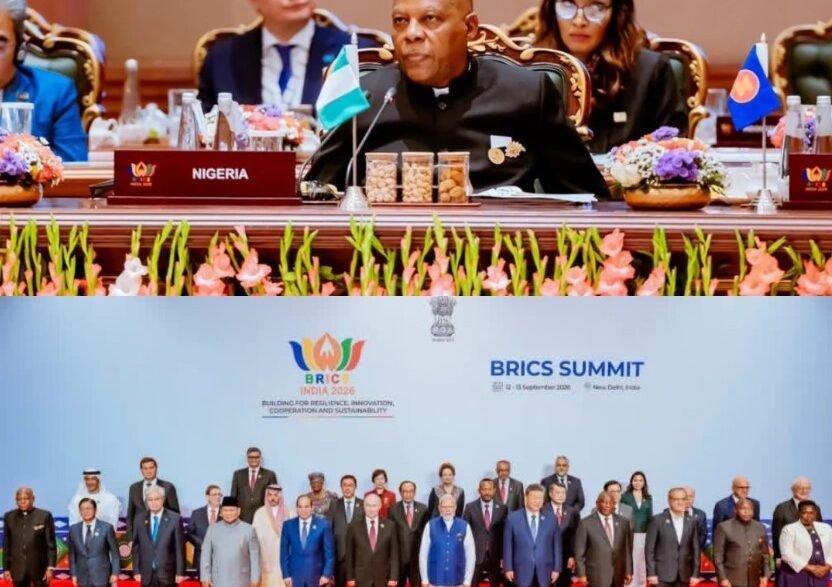
Tinubu made the call on Sunday at the 18th BRICS Leaders’ Summit in New Delhi, India, where Nigeria was represented by Vice President Kashim Shettima.
The President, in an address delivered by Shettima, said Nigeria supports the creation of a more representative, equitable, responsive and effective global governance architecture.
His intervention came as leaders and representatives at the BRICS summit discussed reforms to international institutions and efforts to give developing countries a stronger voice in global decision-making.
The 18th BRICS Summit is being held under the theme, “Building for Resilience, Innovation, Cooperation and Sustainability.” Nigeria has participated as a BRICS partner country since January 2025.
Tinubu seeks more representative global governance
Tinubu argued that the international system needs to evolve to reflect changes in the global economy and population since many of the existing multilateral institutions were established.
According to the President, Nigeria supports reforms that would make global governance structures more representative and responsive to the interests of developing countries.
His position is consistent with Nigeria’s longstanding advocacy for greater representation of African countries in key international institutions.
The call for reform is particularly significant in relation to the United Nations Security Council, whose permanent membership remains limited to five countries — China, France, Russia, the United Kingdom and the United States.
African countries have repeatedly demanded greater representation in the council, arguing that the continent should have a stronger voice in decisions affecting international peace and security.
Tinubu’s intervention at the BRICS summit places Nigeria’s position within the wider push by developing and emerging economies for changes to the international multilateral system.
Nigeria backs reform of UN Security Council
The President’s call for Security Council reform comes against the backdrop of renewed international discussions about expanding the council and improving representation for developing regions.
The BRICS New Delhi Declaration adopted at the summit reaffirmed support for comprehensive reform of the United Nations, including its Security Council.
The declaration called for a more democratic, representative, effective and efficient UN system and backed greater representation for developing countries in the council.
It specifically recognised the aspirations of emerging and developing countries from Africa, Asia and Latin America to play a greater role in international affairs.
Nigeria’s position therefore aligns with the broader BRICS push for changes to the structure of global governance.
For Abuja, the issue is particularly important because Africa has no permanent seat on the UN Security Council despite the continent’s significant population, economic potential and exposure to major peace and security challenges.
Tinubu calls for international financial reforms
Beyond the UN system, Tinubu also called for reforms of the international financial architecture.
Nigeria wants international financial institutions to become more representative and responsive to the needs of developing economies.
The President’s position comes amid growing concerns among emerging economies over the structure of global financial institutions, including the International Monetary Fund and World Bank.
BRICS finance ministers and central bank governors had already called for reforms to international development financial institutions ahead of the leaders’ summit.
They argued that such institutions should become more representative, transparent and accountable and better reflect the changing weight of emerging-market economies in the global economy.
The BRICS New Delhi Declaration similarly called for reforms to the Bretton Woods institutions, saying their governance structures should reflect the transformation of the global economy since the institutions were established.
The declaration also called for greater voice and representation for emerging-market and developing economies.
Nigeria seeks stronger voice for Global South
Tinubu’s intervention reflects Nigeria’s broader foreign-policy objective of strengthening cooperation among countries of the Global South.
Nigeria has increasingly used its BRICS partnership as a platform for expanding economic, diplomatic and development cooperation with emerging economies.
The Federal Ministry of Foreign Affairs said before the summit that Nigeria’s participation was intended to deepen South-South partnerships and advance the country’s interests in trade, investment, energy, agriculture, technology and industrial development.
Shettima is leading a high-level Nigerian delegation that includes Foreign Affairs Minister Bianca Odumegwu-Ojukwu, Industry, Trade and Investment Minister Jumoke Oduwole, Communications, Innovation and Digital Economy Minister Bosun Tijani and Environment Minister Balarabe Lawal.
The delegation is expected to use the summit to strengthen Nigeria’s engagement with BRICS countries and other partner nations.
Shettima represents Tinubu in New Delhi
Tinubu did not personally attend the summit.
Vice President Shettima represented him at the event after arriving in New Delhi with a high-level Nigerian delegation.
The Federal Government said Shettima’s participation provides Nigeria with an opportunity to engage major emerging economies on economic growth, investment, technology, development finance and global governance reforms.
Nigeria became a BRICS partner country in January 2025.
The partnership gives Abuja access to a platform that brings together major emerging economies and provides opportunities for discussions on trade, investment and development cooperation.
BRICS backs reform of global institutions
The Nigerian President’s call also came as BRICS leaders adopted a declaration supporting reforms to global governance.
The New Delhi Declaration said BRICS countries remain committed to promoting a more just, equitable, effective, representative and accountable international system.
The bloc said developing countries should have a greater role in shaping international decisions.
BRICS also reiterated its support for reform of the United Nations and its Security Council.
The declaration said the council should better reflect contemporary global realities and give developing countries greater representation.
The bloc also called for reforms to international financial institutions, including the IMF and World Bank.
Push for IMF and World Bank reforms
One of the central issues raised in the BRICS discussions is the distribution of voting power and representation within international financial institutions.
Emerging economies have argued that their increasing contribution to the global economy should be reflected more adequately in the governance of institutions such as the IMF and World Bank.
The BRICS declaration called for international financial institutions to become more representative, transparent and accountable.
It also backed reforms to IMF quotas and governance, with the objective of increasing the representation and voting shares of emerging-market and developing economies.
For countries such as Nigeria, greater representation could potentially strengthen the ability of developing economies to influence decisions on global financing, debt, development and economic stability.
Nigeria positions itself as gateway to Africa
Beyond institutional reform, Nigeria used the BRICS summit to highlight its economic importance to Africa.
Shettima urged BRICS countries to view Nigeria as a gateway to Africa’s expanding market under the African Continental Free Trade Area.
Nigeria has one of Africa’s largest economies and populations, giving it significant potential as a market and production base.
The government is seeking increased investment in sectors including agriculture, energy, solid minerals, manufacturing, technology and the digital economy.
The BRICS platform provides an avenue for Nigeria to promote these opportunities to major emerging economies.
Focus on technology and investment
Nigeria is also seeking greater cooperation with BRICS countries in technology and innovation.
The Federal Government has identified artificial intelligence, digital technology, manufacturing and technology transfer as areas where stronger international partnerships could support economic development.
The government has also highlighted India’s experience in using technology and artificial intelligence to create opportunities for its large youth population as an area from which Nigeria can draw lessons.
Shettima’s participation therefore extends beyond political discussions to economic diplomacy and efforts to attract investment and technology into Nigeria.
Tinubu’s wider foreign policy agenda
The call for reform at BRICS is consistent with Tinubu’s broader foreign-policy approach, which has emphasised stronger economic partnerships and greater engagement with emerging economies.
Nigeria’s BRICS partnership provides another channel for pursuing these objectives.
The government hopes stronger relationships with emerging economies can help expand markets for Nigerian products, attract investment and support industrial development.
The partnership also gives Nigeria an additional platform to advocate for African interests in discussions on international governance.
Why Security Council reform matters to Africa
Reform of the UN Security Council has remained a major issue for African countries for decades.
Africa currently does not have a permanent seat on the council, despite being significantly affected by decisions concerning international peace and security.
The African Union’s position has consistently called for permanent and non-permanent African representation on a reformed Security Council.
Nigeria has historically been one of the continent’s most active voices in international diplomacy and has previously served multiple terms as a non-permanent member of the council.
For Abuja, permanent African representation would provide the continent with a stronger role in decisions affecting conflicts, peacekeeping, sanctions and international security.
Tinubu’s latest remarks therefore reinforce Nigeria’s support for a long-standing African diplomatic objective.
Global South demands greater representation
The call from Nigeria comes amid a broader push by developing countries for a restructuring of international institutions.
BRICS has increasingly positioned itself as a platform through which emerging and developing economies can coordinate their positions on global economic and political issues.
The bloc’s expansion has further increased its demographic and economic weight.
At the New Delhi summit, leaders emphasised the need for a more multipolar international system and stronger representation for developing countries.
United Nations Secretary-General António Guterres also backed calls for reform of the Security Council and other multilateral institutions during the summit, stressing the need for institutions to better reflect today’s global realities.
Nigeria seeks practical cooperation from BRICS
While calling for reforms, Nigeria is also seeking practical economic benefits from its relationship with BRICS.
The government wants increased cooperation in trade, investment, agriculture, energy, technology, manufacturing and development finance.
Nigeria’s participation is therefore part of an effort to combine diplomatic advocacy with economic opportunities.
The government has said it intends to use its BRICS partnership to deepen South-South cooperation and attract investment into strategic sectors of the Nigerian economy.
For Nigerian businesses, stronger links with BRICS economies could potentially create opportunities for access to larger markets, technology and investment.
A stronger Nigerian voice at global level
Tinubu’s intervention at the 18th BRICS Summit represents another effort by Nigeria to press for changes to institutions that shape global political and economic decisions.
By calling for reform of the UN Security Council and international financial institutions, Nigeria is aligning itself with the broader position of developing economies seeking greater influence in international affairs.
The BRICS New Delhi Declaration’s support for UN Security Council reform and greater representation for developing countries provides a broader platform for that position.
For Nigeria, the challenge will now be translating diplomatic calls into concrete reforms and ensuring that African interests remain central to negotiations over the future of global governance.
Tinubu’s message at the summit was clear: Nigeria wants a global system that reflects today’s economic and demographic realities and gives developing countries a stronger voice.
Through Shettima’s representation at the BRICS summit, Abuja has used the platform to reinforce its support for a more equitable international order while simultaneously pursuing stronger trade, investment and technology partnerships with emerging economies.