Ibadan, Oyo State — November 11, 2025:
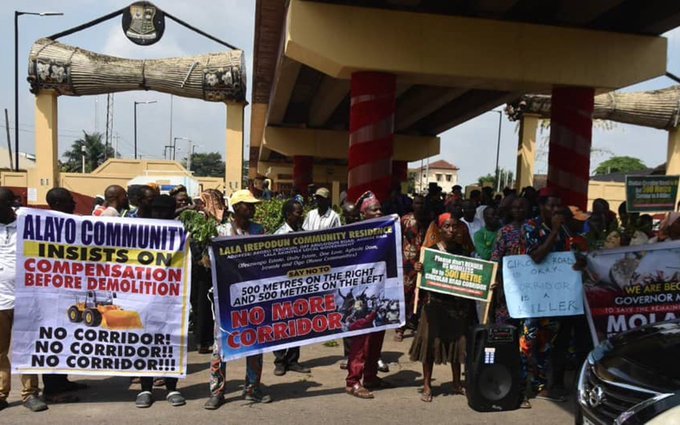
Tension has continued to rise in parts of Ibadan, the Oyo State capital, as residents affected by the ongoing construction of the Rashidi Ladoja Circular Road on Monday staged a protest against what they described as a fresh move by the state government to acquire additional land for the massive road project.
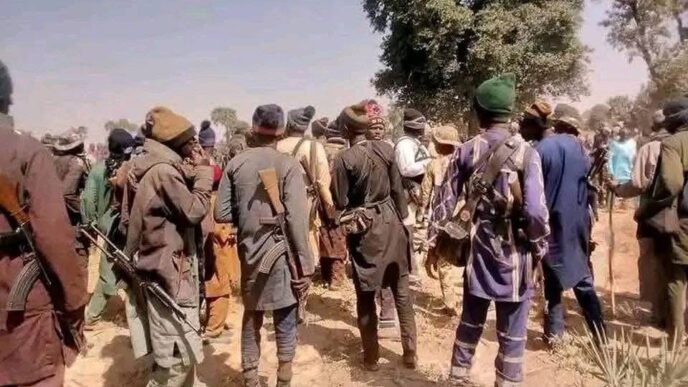
The demonstration, which began early in the morning, drew scores of homeowners, traders, and farmers from communities including Aba Osho, Ajia, Ona-Ara, and Olose, who expressed anger over alleged plans by the government to extend the current road corridor without due notice or compensation.
The protesters, some of whom carried placards reading “We Say No to Forced Acquisition”, “Compensate Us First”, and “We Are Not Against Development, But Be Fair”, demanded an immediate halt to any new demolition exercise.
Residents Cry Out
Speaking to reporters, several community leaders said the new markings on their buildings and farmlands were made over the weekend by survey officials believed to be working for the state’s Ministry of Lands, Housing and Urban Development.
“We were told the earlier land taken was final. Now they are coming back, marking houses again and saying they need additional space for drainage and road expansion,” lamented Mrs. Funke Adebayo, a widow and local trader in Ona-Ara.
“We have lost so much already. Many people are still waiting for compensation from the last phase. We can’t survive another round of demolition.”
Another protester, Mr. Kehinde Adetunji, who owns farmland near the proposed route, accused the government of ignoring community consultations.
“No official meeting was held with us before they started re-marking. Some of us have already spent money rebuilding homes destroyed last year. Now they want to take more land without paying,” he said.
Protest Disrupts Construction Work
The protest temporarily halted work on certain sections of the project, as contractors and heavy equipment operators suspended operations to avoid confrontation.
Eyewitnesses reported that some sections of the site were barricaded by residents carrying placards and chanting solidarity songs.
Security personnel, including officers from the Oyo State Police Command and the Amotekun Corps, were deployed to maintain order and prevent the protest from escalating into violence.
Government Yet to React
As of press time, neither the Oyo State Ministry of Works and Transport nor the Office of the Surveyor-General had issued an official statement on the protest or the alleged new land acquisition.
However, a senior official familiar with the project, who requested anonymity because he was not authorised to speak publicly, said the government was reviewing “engineering recommendations” aimed at improving the alignment, safety, and drainage layout of certain road segments.
“The additional land being considered is not about expanding the project arbitrarily,” the source explained.
“It’s based on technical advice that some sections need to be straightened to prevent flooding and road failure in the future.”
The official added that a new compensation and resettlement framework was being developed to address previous grievances, though he did not confirm when payments would be made.
A Long and Controversial Project
The Rashidi Ladoja Circular Road, first conceived in 2003 under former Governor Rashidi Ladoja, is one of the largest infrastructure projects ever undertaken by the Oyo State Government.
The multi-lane expressway, stretching approximately 110 kilometres, is designed to create a ring around Ibadan, connecting major highways leading to Lagos, Ife, Iwo, and Oyo.
After years of delays and abandoned contracts, construction resumed in 2023 under Governor Seyi Makinde, who described the project as “a strategic investment to decongest Ibadan and boost regional trade.”
Despite significant progress, the project has been dogged by controversies over compensation, environmental impact, and land rights.
Hundreds of residents displaced during earlier construction phases have continued to demand full payment for demolished properties, while others accuse government officials of underpaying or excluding affected families.
Previous Demolition Disputes
In 2023 and 2024, several communities along the East Wing and South-East Wing of the Circular Road corridor staged similar demonstrations, accusing the state government of failing to honour compensation commitments.
According to documents from the Oyo State Bureau of Physical Planning, more than 3,000 structures were marked for demolition across multiple local government areas, including Akinyele, Ona-Ara, and Egbeda.
Many victims claim they were only offered partial compensation, while others received nothing despite repeated verification exercises.
“We were told compensation would come before demolition. Instead, bulldozers arrived first,” recalled Chief Olufemi Adeoti, a landlord from Egbeda.
“People have been patient because we want development, but patience has limits.”
Experts Weigh In
Urban planning experts and civil society groups say the repeated disputes reflect Nigeria’s broader challenges with land governance and infrastructure compensation.
Dr. Bola Akande, a lecturer in urban planning at the University of Ibadan, said the government must balance development goals with human rights obligations.
“No infrastructure project can succeed sustainably without social legitimacy,” Akande noted.
“People displaced by development must be fairly compensated, adequately consulted, and treated with dignity. That is what international best practice demands.”
The Centre for Human Rights and Civic Engagement (CHURCE) also called on the state government to publish a transparent record of compensation payments to date.
“Too often, communities are left in the dark about who is paid and how much,” said CHURCE Director, Mrs. Grace Akinlabi.
“The government must be accountable if it wants citizens to trust the process.”
Government’s Development Push
Governor Seyi Makinde has consistently defended the Circular Road project as a cornerstone of his administration’s infrastructure renewal agenda, aimed at transforming Oyo State into a logistics and investment hub.
In a recent budget speech, the governor stated that the project would attract industrial estates, residential developments, and economic corridors once completed, describing it as “a project for future generations.”
However, residents say that while the long-term benefits are clear, the immediate human cost has been devastating.
“Many families have been displaced with no alternative housing,” said Mrs. Adebayo, one of the protesters.
“Development should not mean destroying people’s livelihoods.”
The Road Ahead
Analysts believe the government must urgently address grievances to avoid further delays and rebuild public confidence.
Transparent engagement, fair compensation, and social inclusion are seen as crucial to the project’s success.
Engineer Kunle Olatunji, a transport consultant based in Lagos, advised that a “structured stakeholder communication plan” be adopted to prevent recurring tensions.
“When communities feel heard and respected, they are more likely to cooperate. That is how major urban projects succeed in other parts of the world,” he said.
Conclusion
As construction machinery rumbles on and fresh disputes emerge, the Rashidi Ladoja Circular Road remains both a symbol of Ibadan’s urban ambition and a flashpoint for social tension.
For thousands of residents living along its path, the dream of progress remains clouded by uncertainty over their land, homes, and future.
Unless the Oyo State Government can strike a balance between infrastructure expansion and citizen welfare, the project’s promise of connectivity may continue to be overshadowed by controversy and resentment.