Washington D.C., November 11, 2025:
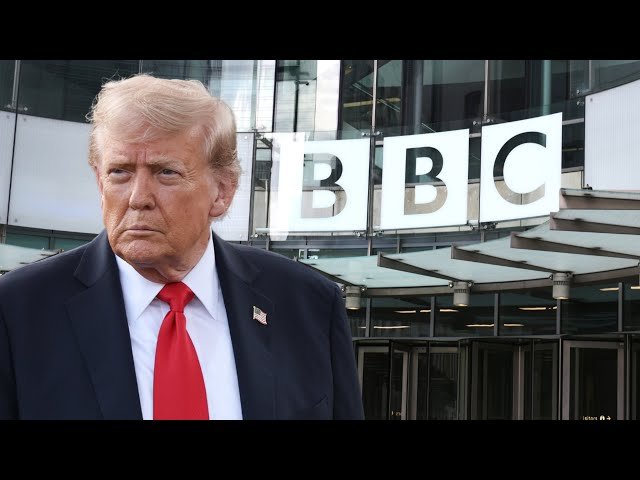
Former U.S. President Donald J. Trump has threatened to sue the British Broadcasting Corporation (BBC) for $1 billion, accusing the media giant of “interfering in the U.S. presidential election” by allegedly editing one of his speeches in a manner that distorted his message.
The legal threat, detailed in a letter from Trump’s attorney Alejandro Brito, was addressed to BBC Chairman Samir Shah at the broadcaster’s Television Centre headquarters in London.
According to the letter, Trump’s legal team alleges that the BBC’s flagship investigative programme Panorama deliberately edited a portion of his address delivered prior to the January 6 Capitol riot, removing a key line in which Trump urged his supporters to demonstrate peacefully.
The Legal Threat
The letter, obtained by several U.S. and British media outlets, accuses the BBC of publishing “fabricated statements” that were later amplified across global digital platforms, causing what Trump describes as “overwhelming financial and reputational harm.”
“President Trump will be left with no alternative but to enforce his legal and equitable rights, all of which are expressly reserved and are not waived, including by filing legal action for no less than $1,000,000,000 (One Billion Dollars) in damages,” the letter reads.
Brito, a Miami-based lawyer, wrote that the broadcaster’s alleged misconduct amounted to defamation and election interference, claiming the doctored footage was used to portray Trump as inciting violence rather than calling for calm.
“Due to their salacious nature, the fabricated statements that were aired by the BBC have been widely disseminated throughout various digital mediums, reaching tens of millions of people worldwide,” Brito stated.
“The BBC is on notice.”
Trump’s Demands
Trump’s legal team issued three demands to the BBC, which must be met by the close of business on Friday:
- A full and fair retraction of the broadcast.
- A public apology acknowledging the alleged error.
- Appropriate compensation to the former president for the harm caused.
Failure to comply, Brito warned, would trigger immediate legal action in both U.S. and U.K. courts.
BBC Leadership Fallout
The controversy comes amid a leadership crisis at the BBC.
Following revelations that Panorama had “selectively edited” the footage of Trump’s January 6 speech, both Director-General Tim Davie and BBC News CEO Deborah Turness have reportedly resigned.
Internal sources told British media that the edit removed a line in which Trump explicitly said:
“I know everyone here will soon be marching over to the Capitol building to peacefully and patriotically make your voices heard.”
Critics say that omission changed the meaning of Trump’s remarks and strengthened the narrative that he encouraged the riot, which left five people dead and hundreds injured.
BBC Yet to Comment
As of Tuesday morning, the BBC had not issued a formal response to Trump’s legal notice. However, a spokesperson told reporters that the broadcaster was “reviewing the correspondence and consulting with its legal advisers.”
The corporation has also launched an internal review into the production of the Panorama episode, which aired in the lead-up to the 2024 U.S. presidential election.
Trump’s History With the Media
This is not the first time Donald Trump has clashed with major media organisations.
Throughout his presidency and post-White House career, he has accused outlets such as CNN, The New York Times, and The Washington Post of publishing “fake news” and misrepresenting his statements.
In 2023, Trump filed a $475 million defamation lawsuit against CNN, alleging that the network compared him to Adolf Hitler in its coverage of his political rhetoric. That case was later dismissed by a federal court in Florida, though Trump’s team vowed to appeal.
Legal experts say his latest threat against the BBC represents a continuation of that strategy — using defamation claims to challenge what he views as media bias against him.
Possible Legal Pathways
If filed, the case could test the limits of cross-border defamation law.
Because the BBC is headquartered in London but broadcasts globally, Trump could theoretically file lawsuits in both U.S. federal courts and U.K. High Court, where defamation laws tend to be more favourable to plaintiffs.
Professor Amelia Hartwell, a media law scholar at Georgetown University, said Trump’s legal team could pursue claims under both jurisdictions.
“In the U.S., Trump would have to prove ‘actual malice’—that the BBC knowingly published false information,” Hartwell explained.
“In the U.K., the standard is lower, but he would still need to show that the editing was misleading and caused serious reputational harm.”
Political Implications
The timing of the lawsuit threat has also raised eyebrows. Trump, who is running for re-election in 2028, has been increasingly vocal about what he calls “foreign interference in American democracy.”
In a brief statement released through his spokesperson, Steven Cheung, Trump said the BBC episode was “part of a coordinated effort by global media elites to rig the 2024 election.”
“They took my words out of context to make me look like a violent man when I was calling for peace,” Trump said.
“They’ll pay dearly for it.”
Political analysts say the move could energize his base, many of whom already distrust traditional media institutions.
Reactions in the U.K.
The BBC scandal has caused a storm in Britain, prompting calls for parliamentary scrutiny into editorial practices.
Opposition politicians have demanded a Parliamentary Media Committee hearing, arguing that the broadcaster’s credibility has been damaged at a critical moment for public trust in journalism.
Sir Julian Knight, a former chair of the Digital, Culture, Media and Sport Committee, said the allegations were “deeply troubling.”
“If Panorama did indeed omit exculpatory language from President Trump’s speech, that would represent a serious breach of journalistic integrity,” he said.
What Happens Next
With the BBC given a Friday deadline to respond, the coming days could determine whether the matter escalates into a full-blown international legal battle.
Observers say that even if the case does not reach court, the threat alone could pressure the broadcaster into issuing a clarification or on-air correction — particularly amid the ongoing resignations within its leadership.
For now, Trump’s message is clear:
“The BBC is on notice,” his lawyer wrote.
“This will not go unchallenged.”