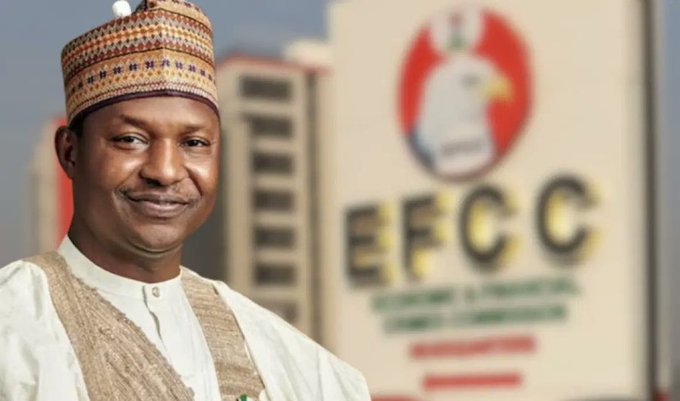
The Economic and Financial Crimes Commission (EFCC) has intensified its anti-corruption drive with a fresh legal move before the Federal High Court in Abuja, seeking the permanent forfeiture of 57 properties allegedly linked to a former Attorney General of the Federation and Minister of Justice, Abubakar Malami.
The anti-graft agency, in a motion on notice filed under suit number FHC/ABJ/CS/20/2026, is asking the court to grant a final forfeiture order transferring ownership of the disputed assets to the Federal Government of Nigeria. The motion was presented by a legal team led by Senior Advocates of Nigeria (SANs), Jibrin Okutepa and Ekele Iheanacho.
The case is being presided over by Justice Joyce Abdulmalik of the Federal High Court in Abuja.
Background to the Case
The EFCC’s application follows an earlier interim forfeiture order granted by the court, which temporarily allowed the government to take control of the properties pending the outcome of investigations and legal proceedings. Interim forfeiture orders are typically issued when assets are suspected to be proceeds of unlawful activities, allowing authorities to preserve them while the court determines their final status.
In its latest motion, the EFCC argued that the respondents failed to provide sufficient evidence to justify overturning the interim forfeiture order. The commission maintains that the properties in question are reasonably suspected to have been acquired through illicit means.
According to court filings, the respondents include Malami, Hajia Bashir Asabe, and Abiru’ Rahman Abubakar Malami, alongside several companies allegedly linked to the assets under investigation.
Legal Basis for Forfeiture
The EFCC grounded its application on Section 17 of the Advance Fee Fraud and Other Fraud-Related Offences Act, 2006. This provision empowers the court to order the forfeiture of assets deemed to be proceeds of fraud or other unlawful activities.
In the motion, the anti-graft agency urged the court to grant:
“A final order of this honourable court forfeiting to the Federal Government of Nigeria, the properties described… which were found by the commission as properties reasonably suspected to be proceeds of unlawful activities.”
Legal experts note that for a final forfeiture order to be granted, the court must be satisfied that the properties are indeed connected to unlawful conduct, even if a criminal conviction has not yet been secured. This is consistent with civil forfeiture proceedings, which differ from criminal trials and focus on the assets themselves rather than the guilt of an individual.
EFCC’s Position
The EFCC, one of Nigeria’s foremost anti-corruption agencies, has continued to deploy asset recovery as a key strategy in combating financial crimes. In this case, the commission insists that its investigations uncovered credible links between the properties and alleged unlawful activities.
The agency further argued that the respondents had ample opportunity to challenge the interim forfeiture but failed to present compelling evidence or documentation to support their claims of legitimate ownership.
According to the EFCC’s legal team, allowing the interim order to be set aside without sufficient justification would undermine ongoing efforts to recover allegedly stolen public assets.
Respondents and Allegations
While the EFCC has not publicly disclosed the full details of the alleged unlawful activities tied to the properties, the inclusion of multiple respondents and corporate entities suggests a complex network of ownership and transactions.
The properties—57 in total—are believed to be spread across different locations, although specific details were not outlined in the initial court filings made available to the public.
The involvement of companies in the suit indicates that investigators are examining whether corporate structures were used to conceal beneficial ownership or obscure the origin of funds used to acquire the assets.
Role of the Federal High Court
The Federal High Court in Abuja plays a critical role in adjudicating high-profile financial crime cases in Nigeria. Justice Joyce Abdulmalik, who is handling the matter, will determine whether the EFCC has met the legal threshold required for final forfeiture.
In such proceedings, the court evaluates affidavits, documentary evidence, and arguments presented by both the applicant (EFCC) and the respondents. If satisfied, the court may grant the forfeiture order, effectively transferring ownership of the properties to the Federal Government.
However, if the respondents succeed in demonstrating that the assets were lawfully acquired, the court may set aside the interim forfeiture and restore ownership.
Implications for Anti-Corruption Efforts
The case is widely seen as a significant test of Nigeria’s asset recovery framework and the EFCC’s capacity to pursue high-profile individuals.
Over the years, the commission has secured several forfeiture orders involving politically exposed persons, public officials, and private individuals accused of financial crimes. However, such cases often generate intense legal battles, with respondents mounting robust defenses to reclaim seized assets.
If the court grants the EFCC’s request, it would mark one of the most substantial asset recoveries involving a former top government official in recent times.
Analysts say the outcome could also reinforce public confidence in the country’s anti-corruption institutions, particularly at a time when transparency and accountability remain key governance issues.
Legal and Political Context
Abubakar Malami served as Nigeria’s Attorney General of the Federation and Minister of Justice from 2015 to 2023, playing a central role in shaping the country’s legal and judicial policies during his tenure.
His time in office was marked by both significant reforms and controversies, making the current proceedings particularly noteworthy.
Legal observers point out that cases involving former high-ranking officials often carry broader political and institutional implications, especially when they intersect with ongoing anti-corruption campaigns.
What Happens Next?
The Federal High Court is expected to hear arguments from both parties before delivering a ruling on the EFCC’s application for final forfeiture.
If the application is granted, the properties will be permanently forfeited to the Federal Government, and the EFCC may proceed with their disposal in accordance with existing regulations. Proceeds from such disposals are typically paid into government accounts.
On the other hand, if the court finds merit in the respondents’ arguments, it may discharge the interim forfeiture order, allowing them to retain ownership of the assets.
Conclusion
The EFCC’s move to secure the final forfeiture of 57 properties linked to Abubakar Malami underscores the agency’s continued focus on asset recovery as a cornerstone of Nigeria’s anti-corruption strategy.
As the case unfolds, it is expected to draw significant public and legal attention, not only because of the profile of the individuals involved but also due to its potential implications for the enforcement of financial crime laws in Nigeria.
The court’s eventual decision will likely serve as a benchmark for similar cases, shaping the trajectory of asset forfeiture proceedings and reinforcing—or challenging—the effectiveness of existing legal frameworks in addressing corruption and financial misconduct.