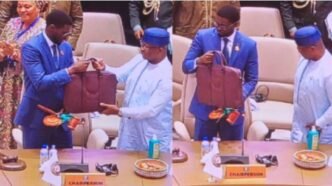
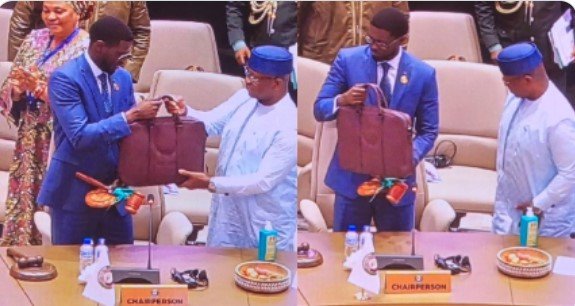
FREETOWN, Sierra Leone — Senegal’s President Bassirou Diomaye Faye has been elected as the new Chairman of the Economic Community of West African States (ECOWAS) Authority of Heads of State and Government, succeeding Nigerian President Bola Ahmed Tinubu after the conclusion of his one-year tenure.
The announcement was made during the 69th Ordinary Session of the ECOWAS Authority of Heads of State and Government held in Freetown, Sierra Leone, where regional leaders gathered to deliberate on pressing political, economic and security issues confronting West Africa.
President Faye’s emergence as ECOWAS Chairman comes at a critical period for the 15-member regional bloc, which continues to grapple with terrorism, unconstitutional changes of government, economic integration, democratic governance and efforts to restore unity following the withdrawal of Burkina Faso, Mali and Niger from the organisation.
The Senegalese leader now assumes responsibility for steering one of Africa’s most influential regional organisations through one of the most challenging periods in its nearly five-decade history.
Tinubu Hands Over ECOWAS Leadership
President Bola Tinubu officially concluded his tenure as Chairman of the ECOWAS Authority after serving for one year.
Tinubu first assumed the chairmanship during the 63rd Ordinary Session of ECOWAS in Bissau, Guinea-Bissau, in July 2023 before being re-elected for another term by regional leaders in 2024.
During his leadership, ECOWAS faced several unprecedented challenges, including military coups in parts of West Africa, negotiations with military-led governments, worsening insecurity across the Sahel and efforts to preserve democratic governance within member states.
His tenure was also marked by diplomatic engagements aimed at restoring constitutional order in countries that experienced military takeovers while strengthening regional cooperation on security and economic development.
At the close of his tenure, Tinubu thanked fellow leaders for their confidence and urged member states to remain committed to regional integration, democratic governance and collective security.
Diomaye Faye Takes Over at a Critical Time
President Bassirou Diomaye Faye assumes office at a moment when ECOWAS faces significant political and security challenges.
The regional bloc has continued to confront violent extremism, terrorism, organised crime, cross-border insecurity and humanitarian crises affecting millions of people across West Africa.
In addition to security concerns, ECOWAS has also been managing diplomatic efforts following the decision of Burkina Faso, Mali and Niger to leave the organisation after disagreements over sanctions and political transitions.
Analysts believe President Faye’s leadership will be closely watched as member states seek to rebuild confidence in regional institutions and strengthen cooperation among West African nations.
His election reflects the confidence placed in Senegal’s leadership within the sub-region.
Who Is President Bassirou Diomaye Faye?
Bassirou Diomaye Faye became President of Senegal in April 2024 after winning the country’s presidential election with a decisive mandate.
His election marked a significant political transition in Senegal and generated widespread attention across Africa due to his reform-oriented campaign centred on transparency, good governance, institutional reforms and economic transformation.
Before becoming President, Faye served as a tax inspector and was a prominent member of Senegal’s opposition movement.
He rose to national prominence alongside Prime Minister Ousmane Sonko and became one of the youngest presidents in Senegal’s history.
Since assuming office, Faye has consistently advocated stronger African cooperation, institutional reforms and policies aimed at promoting economic sovereignty across the continent.
His emergence as ECOWAS Chairman further elevates his role in regional diplomacy.
ECOWAS Faces Complex Regional Challenges
President Faye inherits leadership of ECOWAS during one of the organisation’s most demanding periods.
Among the immediate issues confronting the regional bloc are:
- Persistent terrorist attacks across the Sahel region.
- Armed insurgency and violent extremism.
- Political instability in several member states.
- Economic integration and implementation of regional trade agreements.
- Youth unemployment and economic development.
- Cross-border organised crime.
- Climate-related security challenges.
- Regional infrastructure development.
- Diplomatic engagement with Burkina Faso, Mali and Niger.
Addressing these issues will require sustained cooperation among member states and stronger partnerships with the African Union, the United Nations and international development partners.
Security Expected to Dominate Agenda
Security remains one of ECOWAS’ most urgent priorities.
Several countries across West Africa continue to experience attacks by terrorist organisations and armed criminal groups, resulting in displacement of civilians and humanitarian emergencies.
The region has also witnessed increasing incidents of kidnapping, banditry, illegal arms trafficking and maritime insecurity in the Gulf of Guinea.
Analysts expect President Faye to prioritise enhanced intelligence sharing, joint military cooperation and stronger regional mechanisms for combating terrorism and organised crime.
Many experts believe restoring stability across the Sahel will remain central to his tenure.
Promoting Regional Economic Integration
Beyond security, economic integration remains one of ECOWAS’ founding objectives.
The regional organisation continues implementing initiatives aimed at facilitating free movement of persons, goods and services among member states.
ECOWAS has also pursued programmes designed to improve cross-border infrastructure, regional trade, customs cooperation and investment.
President Faye is expected to encourage accelerated implementation of regional economic policies capable of boosting intra-African trade and supporting sustainable development.
Greater cooperation among member states is considered essential for attracting investment and improving economic resilience across West Africa.
Strengthening Democratic Governance
Democracy remains another major priority for ECOWAS.
Over the past four years, the region has experienced several unconstitutional changes of government that tested the organisation’s commitment to democratic principles.
ECOWAS has consistently maintained that constitutional order and democratic governance remain fundamental conditions for regional stability.
Observers expect President Faye to continue supporting peaceful political transitions, constitutional governance and credible electoral processes throughout the sub-region.
His leadership may also focus on strengthening dialogue between governments, civil society organisations and regional institutions.
Nigeria’s Continued Influence
Although President Tinubu has relinquished the chairmanship, Nigeria is expected to remain one of ECOWAS’ most influential member states.
As West Africa’s largest economy and most populous nation, Nigeria continues to play a leading role in regional peacekeeping, diplomacy, economic cooperation and humanitarian interventions.
Nigeria has historically contributed troops to peacekeeping missions, supported mediation efforts during political crises and provided financial support to ECOWAS programmes.
The transition in leadership therefore represents continuity rather than a reduction in Nigeria’s commitment to regional integration.
Vice-President Kashim Shettima represented President Tinubu during parts of the summit’s proceedings, reaffirming Nigeria’s commitment to the organisation’s objectives.
Expectations from Faye’s Leadership
Regional observers have identified several priorities likely to shape President Faye’s tenure as ECOWAS Chairman.
These include rebuilding unity among member states, strengthening regional security cooperation, advancing economic integration, promoting democratic governance and improving institutional effectiveness.
There are also expectations that he will pursue constructive engagement with countries that have exited the bloc while encouraging dialogue capable of reducing political tensions across the region.
His reputation as a reform-minded leader has generated optimism among some analysts regarding his ability to build consensus among diverse member states.
ECOWAS at 50: Looking Ahead
As ECOWAS approaches its 50th anniversary, the regional organisation continues evolving in response to changing political, economic and security realities.
Established in 1975 to promote regional integration and economic cooperation, the bloc has expanded its role to include conflict prevention, election observation, peacekeeping and democratic governance.
Despite facing numerous challenges, ECOWAS remains one of Africa’s most established regional organisations and continues playing a central role in shaping the future of West Africa.
President Faye’s election comes at a defining moment when renewed leadership, diplomatic engagement and collective action will be essential to addressing the region’s most pressing challenges.
Conclusion
The election of Senegalese President Bassirou Diomaye Faye as the new Chairman of the ECOWAS Authority of Heads of State and Government marks the beginning of a new chapter for West Africa’s premier regional organisation.
Taking over from Nigerian President Bola Tinubu, Faye inherits responsibility for guiding ECOWAS through a period characterised by security threats, political transitions, economic reforms and efforts to strengthen regional unity.
As West African leaders continue working toward peace, stability and sustainable development, the new chairman’s ability to foster dialogue, build consensus and promote collective action will play a significant role in determining the future direction of the sub-region.
With expectations high across the region, President Faye now assumes one of Africa’s most important diplomatic leadership roles at a time when decisive and inclusive leadership is needed to reinforce ECOWAS’ founding vision of unity, prosperity and shared progress among West African nations.