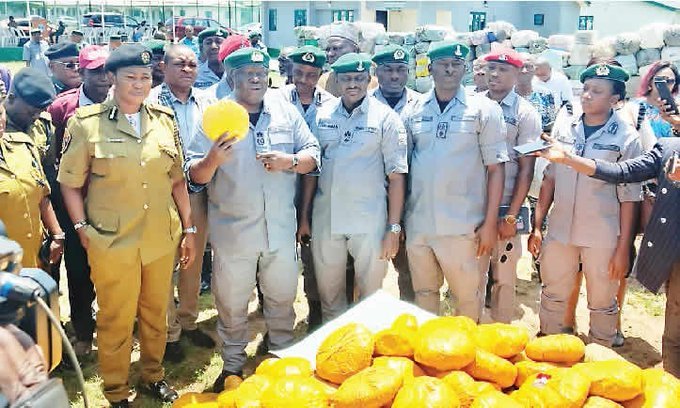
The Nigeria Customs Service (NCS), Seme Area Command, has intercepted a large consignment of contraband goods valued at over N1.99 billion, including 10,000 bags of expired flour imported from Egypt, illicit drugs, and other prohibited items. The seizures were made between September 1 and October 9, 2025, along the Lagos–Abidjan Corridor, a key trans-West African trade route notorious for smuggling activities.
During his maiden press briefing held on Thursday at the Seme Border, the Customs Area Controller, Comptroller Wale Adenuga, disclosed that the expired flour alone had a duty-paid value (DPV) of N1.2 billion. According to him, the product was concealed in five trucks that attempted to enter Nigeria through unapproved routes.
Adenuga warned that the flour, if allowed into Nigerian markets, could have endangered public health, posing risks such as food poisoning, infections, and long-term health complications.
“The seized products were already expired before importation and posed significant health hazards. Unscrupulous importers intended to repackage and resell them to unsuspecting consumers. Our officers’ vigilance prevented what could have been a major public health disaster,” Adenuga stated.
A Major Public Health and Security Threat
According to the Customs Controller, preliminary investigations revealed that the expired flour originated from Egypt and was being ferried through Benin Republic before its interception at Seme. The consignment was falsely declared as fresh food items to evade scrutiny.
He added that the NCS remains committed to ensuring that Nigeria does not become a dumping ground for unsafe or substandard products.
“We are working in line with the Federal Government’s directives to protect local industries and safeguard citizens from harmful products,” Adenuga said. “The Nigeria Customs Service will continue to strengthen border surveillance, improve intelligence gathering, and collaborate with relevant agencies to stop these criminal networks.”
Illicit Drugs and Other Contraband Seized
Apart from the expired flour, the Seme Command also seized several other prohibited items, including:
- Illicit drugs, suspected to be cannabis sativa and tramadol tablets, hidden within legitimate goods;
- Frozen poultry products, concealed in vehicles;
- Petroleum products, smuggled out of the country in jerry cans; and
- Used clothing and footwear, among other restricted goods.
The combined value of these seizures stood at N790 million, bringing the total DPV of confiscated items within the review period to N1.99 billion.
Adenuga attributed the successful operation to enhanced border patrols, strategic intelligence sharing, and the commitment of officers under his command. He commended their efforts, noting that the seizures demonstrate Customs’ resolve to enforce trade regulations despite the challenges posed by Nigeria’s porous borders.
Seme Border: Nigeria’s Gateway and Smuggling Hotspot
The Seme Border, located in Badagry, Lagos State, is one of Nigeria’s busiest and most strategic land borders. It serves as a vital link between Nigeria and the Benin Republic, forming part of the Lagos–Abidjan Corridor, a 1,028-kilometre transnational highway that connects five West African countries — Nigeria, Benin, Togo, Ghana, and Côte d’Ivoire.
The corridor is estimated to handle about 70 percent of West Africa’s trade flow, making it both an economic lifeline and a magnet for illicit activities. Smuggling, trafficking in persons, illegal drug trade, and counterfeit goods have long plagued the route.
Security experts have described the Lagos–Abidjan Corridor as a “double-edged sword” — essential for regional integration but also vulnerable to exploitation by transnational criminal networks.
“The seizure underscores the scale of illegal trade taking place along this corridor,” said a senior border analyst who requested anonymity. “Without constant vigilance and inter-agency cooperation, smugglers can easily exploit weak points in surveillance systems.”
Collaborations and Enforcement Efforts
Comptroller Adenuga emphasized that the Seme Command has strengthened its collaboration with other security agencies, including the Nigeria Police Force, National Drug Law Enforcement Agency (NDLEA), Standards Organisation of Nigeria (SON), and National Agency for Food and Drug Administration and Control (NAFDAC).
These partnerships, he said, have been instrumental in tracking shipments, conducting laboratory tests, and identifying expired or counterfeit goods.
“We are working in synergy with relevant agencies to enhance border management and intelligence-driven operations. Together, we can protect the nation’s economy and public health,” Adenuga said.
He also highlighted the importance of technology and intelligence-led customs operations, revealing that the NCS is improving its use of surveillance drones and scanners to detect concealed contraband.
Revenue Generation and Compliance
In addition to enforcement, the Seme Command recorded steady revenue growth, attributed to improved compliance by legitimate importers and exporters. Adenuga noted that traders and transporters operating through the Seme corridor were increasingly cooperating with Customs to ensure proper documentation and payment of duties.
However, he cautioned that non-compliance and false declarations would continue to attract severe sanctions.
“We are not here to frustrate legitimate trade, but to ensure that all transactions comply with Nigerian law,” he said. “Our commitment to trade facilitation is unwavering, but it must go hand in hand with security and compliance.”
Customs’ Commitment to Border Security
The Nigeria Customs Service has consistently reaffirmed its commitment to curbing smuggling across all borders. The Comptroller-General of Customs, Bashir Adewale Adeniyi, has previously directed all area commands to intensify surveillance, particularly at vulnerable entry and exit points.
This directive aligns with Nigeria’s broader national security strategy, which prioritizes border management as part of efforts to curb illicit trade, arms trafficking, and economic sabotage.
Recent reports from Customs Headquarters show that between January and September 2025, the Service seized contraband worth more than N80 billion nationwide, including vehicles, petroleum products, narcotics, and counterfeit goods.
The N1.99 billion haul from the Seme Command therefore represents a significant contribution to the Service’s enforcement success during the third quarter of 2025.
Public Health Implications of Expired Food Imports
Health professionals have warned that expired food products, such as the seized flour, pose serious health risks to consumers. When expired, flour and similar foodstuffs can harbor harmful bacteria and mycotoxins that cause food poisoning, digestive tract infections, and even long-term diseases such as liver or kidney damage.
A public health officer in Lagos, Dr. Funke Ajayi, emphasized that “expired flour, especially when stored under poor conditions, can produce toxic compounds that are extremely dangerous. If consumed, they can trigger gastrointestinal illnesses, allergic reactions, or chronic organ complications.”
She commended the Customs Service for the interception, noting that public awareness about the dangers of expired and counterfeit food imports remains crucial.
Looking Ahead: Strengthening the Fight Against Smuggling
The Customs Area Controller reaffirmed his commitment to intensifying operations, improving staff welfare, and promoting community engagement to foster mutual trust and intelligence sharing.
“We urge border communities to support our efforts by providing credible information. Together, we can make the Seme Border a model for effective trade facilitation and border security in West Africa,” Adenuga said.
He also stressed the need for regional cooperation among ECOWAS member states, noting that effective control of the Lagos–Abidjan Corridor requires synchronized policies, stronger surveillance systems, and stricter enforcement of cross-border trade regulations.
Conclusion
The N1.99 billion contraband seizure by the Nigeria Customs Service, Seme Area Command, marks another milestone in the nation’s ongoing battle against smuggling, unsafe imports, and economic sabotage. It underscores the crucial role of border management in protecting national security, public health, and economic integrity.
As Nigeria continues to balance its trade liberalization goals with border security imperatives, the Customs Service’s success at Seme Border serves as a reminder that vigilance, collaboration, and enforcement remain the backbone of a secure and prosperous West African trade ecosystem.