


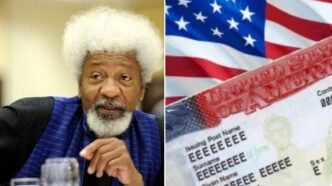

Nigeria’s Nobel Laureate, Professor Wole Soyinka, has revealed that the United States of America has revoked his entry visa, effectively barring him from entering the country. The globally acclaimed writer and human rights activist made the disclosure during a media parley held at the Kongi’s Harvest Gallery, Freedom Park, Lagos Island, on Tuesday, describing the action as both surprising and inexplicable.
The development, which has stirred widespread reactions across literary and diplomatic circles, marks the latest twist in Soyinka’s long and often outspoken relationship with the United States. Speaking to journalists, the 89-year-old Nobel Laureate said he decided to make a public statement to avoid embarrassment for organisers of events in the US who might still be expecting his attendance at future engagements.
“It is necessary for me to hold this conference so that people in the United States who are expecting me for this event or that event do not waste their time,” Soyinka said. “I have no visa; I am banned, obviously, from the United States. And if you want to see me, you know where to find me.”
A Shocking Notification
According to Soyinka, the US Consulate in Lagos formally communicated the visa revocation through an official letter. The letter, which he read aloud to journalists, cited the United States Department of State Regulation 22 CFR 41.122 as the basis for the decision. The correspondence identified the visa as a B1/B2 non-immigrant visa—typically issued for business and tourism purposes—and stated that it had been revoked due to “additional information” that became available after issuance.
The Nobel Laureate said the visa, issued earlier in April 2024, was suddenly declared invalid without any prior notification or invitation for clarification. The letter stated that the visa could no longer be used to enter the United States, leaving Soyinka effectively barred from travel to the country.
He said: “The letter addressed to me clearly stated that the non-immigrant visa earlier issued has been revoked in line with the Department of State’s regulation. It added that additional information had become available after the visa was granted. That is the entire explanation given. No further details, no hearing, no explanation. It is as vague as it is bewildering.”
Soyinka expressed concern over the lack of transparency surrounding the decision, noting that the phrase “additional information” was too ambiguous to justify such a drastic action.
Unaware of Any Wrongdoing
The globally renowned playwright and essayist stated that he was unaware of any actions or incidents that could have warranted such a revocation. “I am completely at a loss,” he said. “I have not committed any offence, I have not violated any immigration laws, and I have not been informed of any security or administrative issue that could explain this development. So I can only assume that it is an institutional action based on some misunderstanding or bureaucratic confusion.”
He also clarified that he holds no grudge against the American people, adding that he still has many friends and admirers in the US, including academics, artists, and human rights advocates. “I will continue to welcome Americans to Nigeria as I always have. My objection is not to the people but to the opacity of the system that allows this kind of arbitrary action without explanation,” he said.
Background to the Visa Controversy
The revocation comes just weeks after Soyinka publicly declined an invitation from the US Embassy in Lagos to appear for a “visa re-interview.” The embassy had sent letters to several valid visa holders in Nigeria, inviting them for re-evaluation of their travel documents. Soyinka said he initially thought the letter was a scam because he had never received such correspondence from any embassy in his lifetime.
“I thought it was some kind of advance-fee fraud,” he recalled. “It was only when I made inquiries that I discovered it was genuine. I declined the invitation because I found the process unnecessary, especially given that I have been travelling to and from the United States for decades without any issues.”
The Nobel Laureate also questioned the choice of September 11—the date the embassy had fixed for his re-interview—saying he considered it inappropriate given its historical significance as the anniversary of the 2001 terrorist attacks in the United States. “I told them I would not be anywhere near their offices on that date. It is far too symbolic a day,” he said.
Soyinka’s Long Relationship with the US
Professor Wole Soyinka, who became the first African to win the Nobel Prize in Literature in 1986, has enjoyed a long-standing relationship with the United States. He has held academic positions at several American universities, including Harvard, Yale, and Emory. His works—spanning drama, essays, poetry, and activism—have been widely studied and celebrated across American academic institutions.
However, Soyinka’s relationship with the US has not been without controversy. In 2016, shortly after the election of Donald Trump, he announced that he would destroy his US Green Card in protest against what he described as a rise in divisive politics and xenophobia. He indeed confirmed later that he tore up the card, symbolically severing his permanent resident ties with the country.
Despite that symbolic gesture, Soyinka continued to travel to the United States for lectures, book tours, and public speaking engagements. His latest visa, issued in 2024, was supposed to remain valid for several years before the abrupt revocation.
Implications of the Revocation
The revocation of Soyinka’s visa has raised broader questions about US-Nigeria relations, visa policies, and transparency in immigration decisions. For Nigeria’s intellectual community, the incident is seen as both embarrassing and troubling. Several commentators have argued that the decision undermines the spirit of cultural diplomacy between both countries.
Analysts say the case could also highlight a broader tightening of US visa policies toward Nigeria. In recent months, the US Embassy in Lagos has modified its visa reciprocity arrangements, restricting non-immigrant visas to single-entry permits valid for three months instead of multiple entries spanning five years. The new policy has resulted in a significant number of re-interview invitations and revocations.
Immigration experts note that under US law, the State Department has the discretion to revoke a visa at any time, even after issuance, if new information arises that may affect the applicant’s eligibility. However, such revocations are usually accompanied by clear reasons or opportunities for appeal—something missing in Soyinka’s case.
Public and Diplomatic Reactions
Although the United States government has not yet issued an official explanation for the revocation, reactions in Nigeria have been swift. Many Nigerians, especially within academic and literary circles, expressed outrage and disbelief over the development, describing it as a disrespect to one of Africa’s most distinguished intellectuals.
Social commentators have urged the Federal Government to engage the US authorities diplomatically to clarify the situation. Some have even suggested that the Nigerian government should take a firmer stance when similar actions affect high-profile citizens.
Soyinka himself, however, appears to be taking the matter in stride. “This is not a personal war,” he said. “It is simply an administrative decision that, in my view, is unjustified. I am not begging anyone for a visa. I have travelled enough in my lifetime. If they want to see me, they know where to find me.”
Broader Questions of Transparency
The incident has renewed debate over the transparency of the US visa system and the balance between national security and fairness. Legal experts note that while every country has sovereign rights to grant or deny visas, the manner of execution often determines the level of trust and diplomatic goodwill.
Soyinka’s case is particularly notable because of his stature and contributions to global literature and human rights. Observers believe that if such an internationally respected figure can have his visa revoked without explanation, ordinary citizens may face even greater uncertainty in their dealings with foreign embassies.
Looking Ahead
For now, it remains unclear whether the revocation is permanent or if Soyinka will be eligible to reapply in the future. The Nobel Laureate has not indicated any intention to appeal the decision or seek intervention from the Nigerian government.
The development, however, underscores the shifting dynamics in global travel regulations and the vulnerability of even the most prominent citizens to bureaucratic discretion. As Soyinka himself put it, “I am too old to be running around embassies explaining myself. Let them keep their visa if they wish. I’ll keep my dignity.”
The controversy surrounding the revocation continues to spark conversations about justice, transparency, and the treatment of African intellectuals on the global stage. For many observers, the episode is more than just a bureaucratic misstep—it is a reflection of how power and process can intersect in ways that test the principles of fairness and respect.
As the world watches for a response from the US authorities, one thing is certain: Wole Soyinka’s voice, whether in Lagos or Lagos, Maine, remains as powerful as ever—undaunted by borders, bureaucracy, or silence.


