


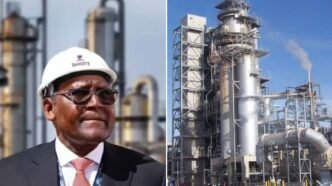

DANGOTE REFINERY RECALLS SACKED ENGINEERS AMID INDUSTRIAL PEACE EFFORTS
— Re-employed staff deployed to Benue, Borno, Zamfara, others
In a major turnaround following weeks of industrial tension, the management of Dangote Refinery has re-employed dozens of engineers who were sacked during last month’s dispute with the Petroleum and Natural Gas Senior Staff Association of Nigeria (PENGASSAN).
Reliable sources within the company confirmed that the affected engineers have been recalled and redeployed to various Dangote Group projects across the country, including Borno, Benue, Zamfara, Ebonyi, Kebbi, Niger, and Sokoto States.
According to findings, the re-engagement followed a series of quiet negotiations between the company’s human resources department and officials of PENGASSAN aimed at restoring industrial harmony after the face-off that led to protests and a temporary shutdown of parts of the refinery operations in September 2025.
Background of the Dispute
The dispute between Dangote Refinery and PENGASSAN had escalated in September when several engineers and technical staff were dismissed over what management described as “internal restructuring and performance review outcomes.”
However, PENGASSAN strongly opposed the move, accusing the company of victimizing its members and breaching the principles of fair labour practice. The union had at the time threatened to picket the refinery, Nigeria’s largest industrial complex, until the sacked staff were reinstated.
The refinery, which is regarded as a national economic asset with a production capacity of 650,000 barrels per day, is central to Nigeria’s energy security agenda. Its temporary operational slowdown during the labour unrest had sparked concerns about potential delays in full-scale domestic refining.
After weeks of behind-the-scenes dialogue involving senior officials from the Ministry of Labour and Employment, the matter was reportedly resolved amicably — paving the way for the recent recall of the affected engineers.
Re-Employment and Redeployment
Our correspondent gathered that the re-engaged engineers were notified via official communication from the Dangote Group’s human resources department last week. They were invited to the company’s head office in Lagos to receive their re-employment and redeployment letters.
Some of the recalled engineers were said to have been redeployed to Dangote Coal Mine operations in Benue State, while others were sent to ongoing concrete road construction projects in Borno and Ebonyi States.
Additionally, a number of them have been assigned to Dangote Rice Mills and Integrated Agricultural Projects in Kebbi, Niger, Sokoto, and Zamfara States, marking a strategic shift in staff utilization across the conglomerate’s subsidiaries.
One of the affected engineers, who spoke on condition of anonymity because he was not authorized to comment, told our correspondent:
“We were called back and asked to report to different subsidiaries under the group. Some of us have been posted to the rice mills, others to road projects, and a few to the Benue coal mine. The most important thing is that we’ve been reinstated and can continue our careers.”
Another source within the refinery confirmed that the redeployment is part of the company’s effort to optimize its manpower structure and ensure that skilled professionals are retained within the group, even if not directly within the refinery’s operations.
“The management realized that losing trained engineers at this stage would be counterproductive, especially when the refinery is expanding its technical base,” the source explained. “The new arrangement allows these staff to contribute meaningfully to other ongoing projects within the Dangote Group.”
PENGASSAN’s Position
Officials of PENGASSAN were said to have been involved in the resolution process, insisting that the rights of workers must be protected under Nigeria’s labour laws.
While the union has not yet issued a formal statement on the recall, a senior PENGASSAN representative confirmed that dialogue between the association and Dangote management had yielded “constructive results.”
“Our position from the beginning was clear — no employee should be unjustly dismissed, especially during a sensitive period of national economic transition. We are pleased that the management has reconsidered and taken steps to address the grievances,” the union official said.
He added that PENGASSAN remains open to continued engagement with private sector employers to promote industrial harmony, noting that “the Dangote case underscores the importance of communication, transparency, and adherence to due process in labour relations.”
Efforts to Stabilize Operations
Since the dispute, Dangote Refinery has intensified efforts to stabilize operations and reassure both workers and investors of its commitment to fair labour practices.
Insiders say the management has reviewed its human resource policies to prevent future misunderstandings and to align more closely with global corporate governance standards.
The refinery’s management reportedly held internal meetings to brief supervisors and department heads on maintaining better communication channels with employees. There are also ongoing discussions about introducing new welfare initiatives and training opportunities for technical staff to improve morale and retention.
A senior HR manager at the company, who requested anonymity, said:
“What happened last month was unfortunate but also instructive. We are taking proactive measures to ensure that similar incidents do not repeat themselves. The re-engagement of the engineers shows our willingness to resolve issues amicably and move forward as one team.”
Impact on Refinery Projects
The recall of engineers is also expected to boost manpower availability at the refinery’s auxiliary sites. With the refinery ramping up operations toward achieving 100% utilization by 2026, technical expertise remains critical to ensuring efficiency across its engineering and maintenance units.
Industry analysts say the decision to retain and redeploy trained personnel within the group demonstrates strategic foresight by the management.
According to energy analyst Oluwole Adetayo, “Technical staff are the backbone of refinery operations. Training them takes time and huge resources. The decision to reabsorb them, even in other units, helps preserve institutional knowledge and signals stability to investors.”
A Broader Industrial Lesson
The Dangote–PENGASSAN episode has also reignited conversations about labour relations in Nigeria’s growing private industrial sector. Experts believe that as the country diversifies from crude oil exports to value-added refining and manufacturing, corporate leaders will need to invest more in human capital development and structured labour engagement.
Labour consultant Dr. Chioma Nwosu told our reporter that “this case offers a valuable precedent for how disputes should be resolved — not through confrontation but through meaningful dialogue that balances business realities with workers’ rights.”
She emphasized that with the refinery being a flagship project for Nigeria’s industrialization drive, “industrial peace within such a facility is not just a company matter; it’s a national economic concern.”
Moving Forward
For the re-employed engineers, the recall brings relief and a renewed sense of purpose after weeks of uncertainty. Many of them were graduate trainees undergoing specialized technical induction when the initial termination was announced.
Now, with new deployment opportunities across the group, they will continue contributing to the conglomerate’s wide-ranging projects spanning energy, agriculture, mining, and construction.
The Dangote Group’s decision appears to have calmed what could have escalated into a prolonged labour standoff capable of disrupting Nigeria’s energy reform agenda.
As one industry observer noted:
“This resolution is a win-win — for the workers, for the company, and for Nigeria’s economy. It demonstrates that corporate responsibility and dialogue can coexist with business ambition.”
Conclusion
With the recall of the dismissed engineers, Dangote Refinery has taken a decisive step toward restoring full industrial peace and rebuilding confidence among its workforce. The move also reinforces the company’s public image as a key national employer committed to fair practices and long-term development.
As the refinery continues its march toward full operational capacity, the focus now shifts to sustaining stability, expanding skill retention programs, and ensuring that labour-management relations remain grounded in mutual respect and transparency — a vital ingredient for Nigeria’s industrial future.
Word count: ~1,170


