
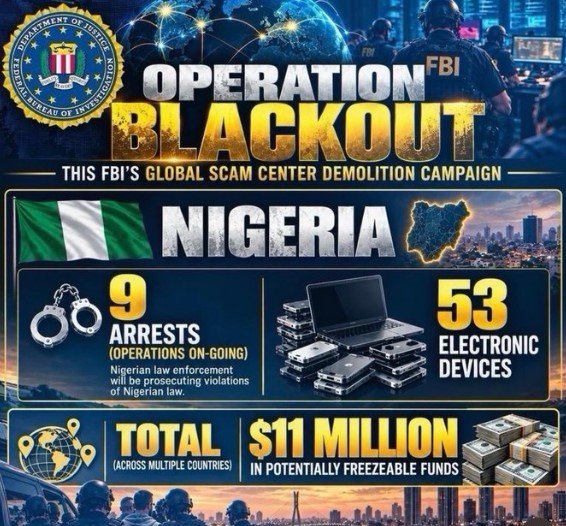
The operation, code-named Operation Blackout, also resulted in the seizure of 53 electronic devices in Nigeria and the identification of approximately $11 million in funds considered potentially eligible for freezing across multiple countries.
FBI Director Kash Patel disclosed the development in a statement published on Sunday, October 25, 2026, highlighting the agency’s efforts to dismantle criminal networks that allegedly use digital platforms and organised fraud schemes to steal money from victims across international borders.
The announcement comes amid an intensified international campaign against cybercriminal groups operating in West Africa, with law enforcement agencies working alongside technology companies to identify suspects, disrupt fraudulent online accounts and trace funds linked to suspected criminal activities.
Patel said the operation demonstrated that cybercriminals could no longer assume that operating from another country would protect them from investigation and prosecution.
According to the FBI director, the networks under investigation exploit innocent people, with some victims losing their life savings to fraudulent schemes.
He also commended Nigerian law enforcement agencies and international partners for their cooperation in the operation.
The arrests represent a significant development in efforts to combat cross-border cybercrime, which has become a major concern for governments, financial institutions, technology companies and individuals affected by online fraud.
Operation Blackout: FBI Confirms Nine Arrests in Nigeria
In his statement, Patel described Operation Blackout as part of a broader effort to confront international criminal networks accused of stealing billions of dollars from Americans.
The FBI director said the latest operation in Nigeria resulted in nine arrests and the seizure of 53 electronic devices.
He also disclosed that investigators identified $11 million in potentially freezable funds across multiple countries.
The identification of funds potentially eligible for freezing is an important aspect of financial crime investigations because it can help authorities trace suspected proceeds, prevent the movement of assets and support efforts to recover money for victims where legally possible.
However, the identification of funds does not necessarily mean that the entire amount has been frozen, confiscated or recovered. Authorities would need to establish the relevant legal grounds and follow applicable procedures before such measures could be completed.
Patel said the operation targeted networks that allegedly operated across national boundaries and exploited the difficulties law enforcement agencies sometimes face when investigating crimes involving multiple jurisdictions.
He credited Nigerian law enforcement officials and partners in London for their cooperation, stressing the importance of international collaboration in tackling online fraud.
The FBI has continued to work with foreign authorities on investigations involving suspected cybercriminals whose alleged activities affect victims in the United States.
The latest arrests also underscore the growing importance of cooperation between investigators in the United States and their counterparts in Nigeria, particularly where electronic evidence, financial transactions and suspects may be located in different countries.
Wider International Crackdown on Online Scam Networks
The arrests in Nigeria form part of a wider international enforcement campaign against transnational scam networks operating in West Africa.
In a separate announcement on October 13, 2026, the United States Department of Justice disclosed the results of a coordinated law enforcement and private-sector initiative targeting online scam accounts and criminal networks operating in the region.
The wider operation involved the FBI, the United States Secret Service, the Department of Justice, Homeland Security Investigations, the United Kingdom’s National Crime Agency, Nigerian law enforcement agencies and Ghanaian authorities, alongside international partners and technology companies.
According to the Department of Justice, authorities made 28 arrests in Nigeria and Ghana during the coordinated enforcement period.
In Ghana, authorities arrested 19 people in the Accra suburb of Sasaabi and seized 303 electronic devices. The same announcement reported that nine individuals were arrested and 53 electronic devices seized in Nigeria.
The figures reported for Nigeria correspond with the latest announcement by the FBI director.
The wider operation also involved efforts to identify potential victims of trafficking, disrupt fraudulent online accounts and trace money linked to suspected scams.
US authorities said participating technology companies removed more than 3.7 million accounts, pages and groups allegedly associated with fraudulent activities targeting people in the United States, the United Kingdom and elsewhere.
The companies also shared intelligence on suspected scam centres with law enforcement agencies, helping investigators identify possible criminal activity and support enforcement actions.
The coordinated initiative illustrates how online fraud investigations increasingly depend on collaboration between law enforcement agencies and private companies that operate social media platforms, cryptocurrency services, digital infrastructure and other technologies.
Rather than relying solely on arrests, authorities are also seeking to disrupt the systems used to contact victims, impersonate legitimate organisations, move stolen funds and sustain fraudulent operations.
Types of Cybercrime Targeted by Investigators
The US Department of Justice said the wider international crackdown targeted several forms of online fraud, including impersonation scams, extortion schemes and cryptocurrency investment fraud.
One category involves criminals pretending to be law enforcement officers or government officials to frighten victims into transferring money or disclosing sensitive financial information.
In some cases, fraudsters may claim that a victim is under investigation, faces arrest or must pay a purported fine to avoid legal consequences. Such demands can be designed to exploit fear and prevent victims from independently verifying the claims.
Another category is digital arrest extortion, in which criminals use threats, fabricated allegations or false claims of official authority to pressure people into paying money.
Investigators also targeted cryptocurrency investment scams, sometimes described as “pig butchering” fraud. These schemes typically involve criminals building trust with victims before persuading them to invest money in fraudulent platforms or purported investment opportunities.
Fraudsters may initially display fabricated profits or allow limited withdrawals to convince victims that an investment is legitimate. Once victims transfer larger sums, the criminals may demand additional payments or prevent them from accessing their money.
The US authorities said the disrupted operations also included other online fraud schemes targeting victims internationally.
The specific allegations against the nine suspects arrested in Nigeria have not been publicly detailed in the available announcement. It would therefore be premature to attribute a particular scam method, financial loss or individual victim to any of the suspects.
$11 Million Identified as Potentially Freezable Funds
One of the most significant findings from the broader operation was the identification of approximately $11 million in potentially freezable funds across multiple countries.
The amount highlights the financial dimension of cybercrime investigations, which frequently extend beyond identifying the individuals allegedly responsible for online fraud.
Investigators may need to examine bank transfers, cryptocurrency transactions, digital wallets, payment platforms and other financial records to establish where suspected proceeds have gone.
Funds linked to suspected criminal activity can sometimes be moved through several accounts or jurisdictions in an attempt to obscure their origins and make recovery more difficult.
International cooperation can help authorities obtain information from financial institutions, identify suspicious transactions and seek appropriate legal orders to preserve or recover assets.
However, the distinction between identifying potentially freezable funds and recovering stolen money is important.
The $11 million figure does not establish that the entire amount belonged to the Nigerian suspects or that it was stolen from a single group of victims. It refers to funds identified across multiple countries during the broader enforcement effort.
The final amount that could be frozen, forfeited or returned to victims would depend on the evidence, the applicable legal procedures and the outcome of further investigations.
The operation nevertheless demonstrates the importance of combining criminal investigations with financial intelligence to disrupt networks that allegedly profit from online fraud.
Technology Companies Assist International Investigations
The wider crackdown also involved technology companies that provided information and took steps to disrupt accounts and online infrastructure allegedly used in fraudulent activities.
According to the US Department of Justice, participating companies removed more than 3.7 million accounts, pages and groups targeting people in the United States, the United Kingdom and other locations.
The companies also provided leads on more than 30 suspected scam centres to law enforcement agencies.
Such cooperation can help investigators identify suspicious accounts, connect seemingly unrelated activities and establish how online platforms are being used to contact potential victims.
Fraudulent accounts may be used to impersonate trusted individuals, advertise fake investments, establish fictitious romantic relationships or direct victims to websites designed to collect personal information and money.
Removing suspicious accounts can disrupt some of these activities, although it does not necessarily identify every individual behind them or prevent criminals from creating new accounts.
Law enforcement agencies therefore combine platform intelligence with traditional investigative methods, digital forensics and financial tracing.
The 53 electronic devices seized in Nigeria could potentially provide evidence relevant to the investigation. Depending on the devices and the available legal authority, forensic examinations may help establish communications, account ownership, transaction records and links between suspected participants.
The seizure itself, however, does not establish that every device contained evidence of a crime. That determination requires examination by investigators.
Cybercrime and the Financial Cost to American Victims
The crackdown comes amid continuing concerns about the financial impact of online fraud in the United States.
The FBI’s Internet Crime Complaint Center reported 72,984 investment scam complaints in 2025, according to figures cited by the Department of Justice in its October announcement.
Cryptocurrency-related investment fraud accounted for 72 per cent of that category, while reported losses from investment scams increased from $3.96 billion in 2023 to $5.8 billion in 2024.
The department also said reported losses associated with investment scams involving cryptocurrency exceeded $7.2 billion in 2025, representing a 24 per cent increase.
These figures illustrate the scale of the problem, although they represent reported losses and should not be interpreted as a complete measure of all cybercrime worldwide.
Some victims do not report incidents because of embarrassment, fear of reputational damage or uncertainty about which authority to contact. Others may not realise they have been deceived until much later.
Online fraud can have consequences beyond immediate financial losses. Victims may lose retirement savings, incur debts, experience emotional distress or struggle to recover after transferring money to criminals.
Older people, inexperienced investors and individuals seeking relationships or additional income can be particularly vulnerable to certain forms of deception, although anyone using digital services can become a target.
The international operation reflects growing recognition that online fraud requires responses that extend beyond national borders.
Implications for Nigeria’s Cybercrime Enforcement Efforts
The arrest of nine suspects and seizure of 53 devices place renewed attention on Nigeria’s efforts to investigate cybercrime and cooperate with foreign law enforcement agencies.
Nigeria’s participation in the wider enforcement campaign involved local law enforcement bodies, including the Nigerian Joint Case Team on Cybercrimes and the Nigeria Police Force National Cybercrime Centre, according to the US Department of Justice.
International cooperation is particularly important when alleged offences involve victims abroad, digital accounts hosted in other countries and money transferred through international payment systems.
Investigators must establish the facts of each case, preserve electronic evidence and follow the relevant legal procedures. Where prosecution is pursued, the evidence must support the charges brought against individual suspects.
The arrests should not be taken as evidence that Nigerians generally are involved in cybercrime. Criminal allegations concern specific individuals and conduct, and responsibility must be determined on the available evidence.
For legitimate Nigerian businesses, technology professionals and digital entrepreneurs, tackling online fraud is also important for maintaining trust in the country’s growing digital economy.
Fraud can damage the reputation of legitimate online businesses, make international customers more cautious and increase the compliance burdens faced by financial institutions and service providers.
Effective enforcement, public awareness and cooperation with international partners can help protect victims while supporting lawful digital commerce.
What Happens After the Arrests?
The next steps in the investigation may include forensic examination of the seized devices, analysis of financial transactions, interviews with relevant individuals and efforts to establish whether the suspects were connected to wider criminal networks.
Authorities may also investigate whether additional suspects, accounts or assets are linked to the alleged schemes.
However, the precise status of the nine suspects, the location of their arrests, any charges filed against them and the timetable for possible prosecution have not been established in the public announcement.
An arrest is not a conviction, and the allegations must be tested through the appropriate legal process.
The identification of electronic evidence or suspected financial proceeds does not automatically establish criminal responsibility. Investigators and prosecutors must demonstrate the relevant facts against each individual.
The FBI has indicated that it will continue working with international partners to pursue networks targeting Americans from overseas.
For Nigeria, the operation reinforces the importance of credible investigations, effective digital forensics and cooperation with foreign authorities while respecting the rights of suspects and the requirements of due process.
Conclusion
The FBI’s announcement of nine arrests in Nigeria, the seizure of 53 electronic devices and the identification of $11 million in potentially freezable funds marks another development in the international campaign against cybercrime.
The operation forms part of a wider effort involving US and UK agencies, Nigerian and Ghanaian authorities, and private-sector technology companies to disrupt online fraud networks operating across national boundaries.
While the arrests represent a significant enforcement development, important questions remain about the individual allegations, the evidence recovered and whether any identified funds will ultimately be frozen or returned to victims.
As investigations continue, authorities face the challenge of identifying those responsible, disrupting the infrastructure used to commit fraud and ensuring that victims have a meaningful opportunity to seek justice.
The outcome will depend on the evidence gathered and the legal processes that follow, rather than the number of arrests or devices seized alone.